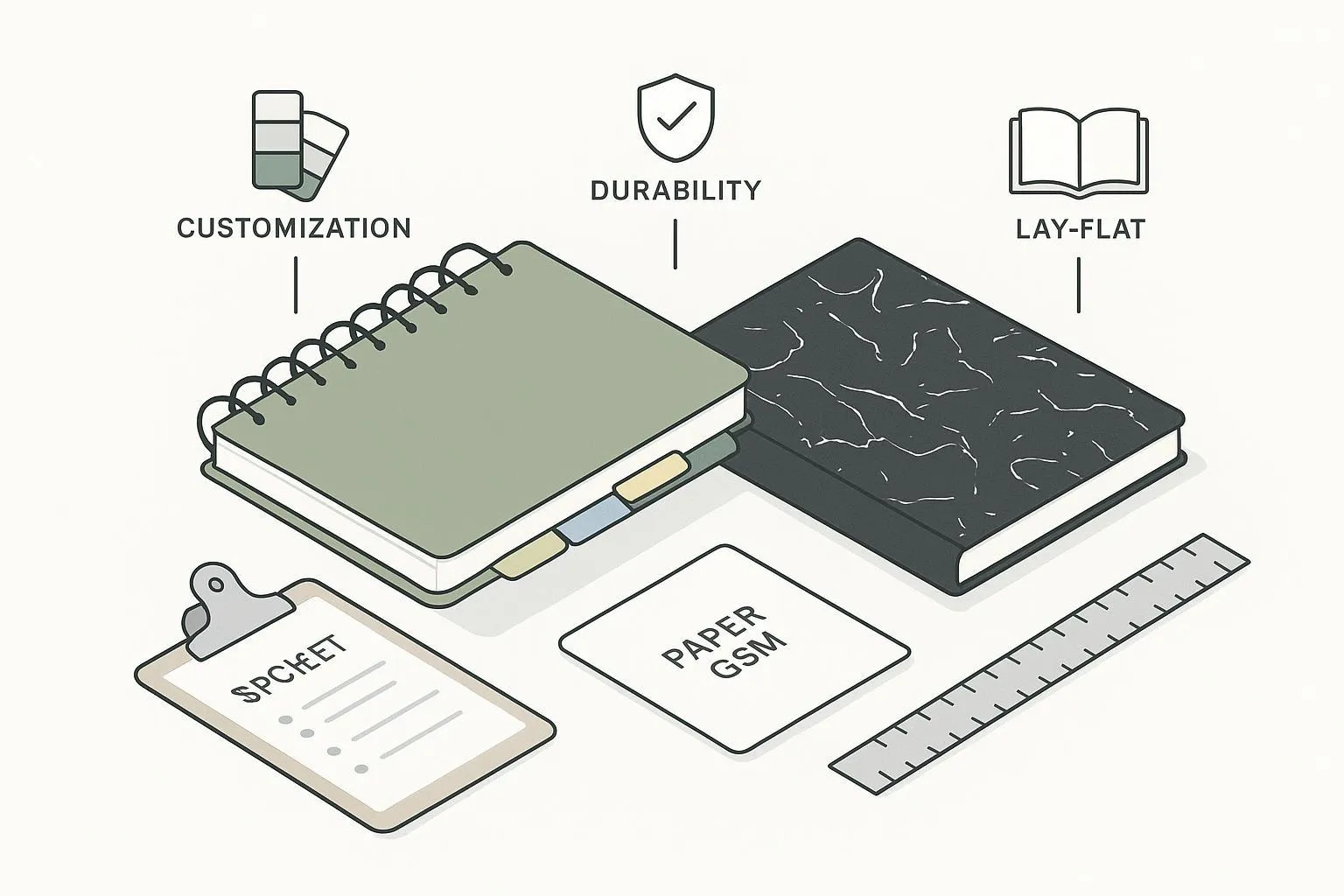
Quick verdict (for busy buyers):
- Daily classwork and clean homework tear‑outs: choose spiral (coil) for 360° fold‑back and micro‑perforation.
- Archival records, tamper‑evident logs, and formal appearance: choose stitched (Smyth‑sewn/composition).
- Art classes and left‑handed accessibility: spiral usually wins for the flattest, fold‑back writing plane.
- Younger grades and rough handling where coils may snag: stitched often holds up better and has safer edges.
At‑a‑glance: Spiral vs Stitched Notebooks — School Procurement
Two formats, two strengths. Use the table below to match format to scenario with OEM/custom choices in mind.
| Feature | Why it matters | Spiral (coil) | Stitched (Smyth‑sewn / composition) | When to choose |
|---|---|---|---|---|
| Typical sheet counts | Fit class length and usage | Common ~70/80/100/120 sheets; multi‑subject with dividers | Common ~70/80/100 sheets; usually single‑subject | Multi‑subject needs → Spiral; simple, durable single‑subject → Stitched |
| Paper options (GSM) | Reduce bleed‑through; writing feel | 75–90 GSM common; higher GSM available | 75–90 GSM common; higher GSM with casebound options | Standard classes (80–90 GSM) → either; art/premium → spec higher GSM |
| OEM & branding options | School logos, colors, functions | Broad menu: coil colors, micro‑perforation, tabs/dividers, pockets, elastic, pen loop, cover materials/finishes | Strong covers and print; tabs/perforation less typical | Need tabs/perforation/multi‑subject → Spiral; classic, tamper‑evident branding → Stitched |
| Durability & page retention | Survive a school year; avoid loose pages | Good for frequent handling; coil can deform if crushed | Excellent long‑term page retention; tamper‑evident | For records/rough backpacks → Stitched; everyday use with care → Spiral |
| Lay‑flat & ergonomics | Speed and comfort in class | True 360° fold‑back; lays perfectly flat | Lays flat open, but no 360° fold‑back | Left‑handers/small desks → Spiral; reading/reference → either |
| Page removal / perforation | Homework and hand‑ins | Micro‑perforation is common for clean tear‑outs | Clean tear‑outs atypical; pages meant to stay | Frequent tear‑outs → Spiral; preserve all pages → Stitched |
| Capacity & dividers | Organize subjects/projects | Easy to add dividers/tabs and pockets | Single‑subject; dividers uncommon | Multi‑subject courses → Spiral |
| Classroom safety & edges | Snag risk and sharp points | Exposed coil; plastic coils mitigate snags | Closed spine; fewer snag points | Younger grades/rough use → Stitched (or plastic‑coil Spiral) |
| Aesthetics & formal use | Professional/official look | Casual/functional | More formal, especially casebound | Official records/logs → Stitched |
| MOQ & pricing (illustrative) | Budgeting bulk buys | Factory OEM often ~500–1,000 MOQ; as of 2026‑01‑23, basic school builds seen around ~$0.32–$1.10 at 5k/1k; subject to change | Similar MOQ; basic sewn softcover overlaps spiral pricing (~$0.45–$1.50 at 5k/1k); hardcover higher; subject to change | Tight budgets may favor simpler specs; confirm current quotes |
| Lead times & scale | Back‑to‑school readiness | Factory runs often ~15–35 days after sample approval | Similar factory timing; casebound can add days | Plan buffers around term starts; sample early |
| Sustainability & compliance | School procurement standards | FSC/PEFC papers available through many OEMs | Same; audits/tests vary by supplier | Verify certificates and audit validity with vendor |
| Best classroom scenarios | Fast picks | Daily notes, art, left‑handers, tear‑outs | Records/logs, younger grades where coils snag | Scenario‑based rather than one overall winner |
OEM & branding customizability (lead decision factor)
For K–12 and campus retail, customization determines whether the notebook works for real classroom workflows. Spiral formats typically offer the widest functional menu: coil color choices, micro‑perforation on each sheet, subject dividers and tabs, poly pockets, pen loops, and elastic closures. These are common in OEM catalogs and retail specs; micro‑perforated spiral pages, for instance, are standard on many school SKUs, as shown on retailer listings like the perforated spiral notebook category at Staples in the form of the “perforated pages” filter within their dedicated spiral range, documented by the descriptive listing page in the retailer’s category for perforated spiral notebooks: Staples’ retailer category for perforated spiral notebooks.
Stitched (Smyth‑sewn/composition) notebooks support robust cover branding (hard/soft cover, printed patterns, foil, lamination) and clean spines, but they’re less often paired with tabs, multi‑subject dividers, or page‑by‑page perforation. In short: if your spec requires tabs/dividers and clean tear‑outs, spiral tends to be the easier OEM path; if you need tamper‑evident, intact books with a formal look, stitched excels.
Typical OEM bands (plan buffers): small digital runs in the U.S./EU can turn in days, while factory OEM runs often need 15–35 days after sample approval. For context, a common lead‑time range for book/notebook printing is summarized in the manufacturing guidance from BookPrintingChina’s lead‑time explainer, which notes 10–18+ production days depending on spec complexity: see the overview in the publisher’s explainer on schedules, BookPrintingChina’s lead time overview.
Durability and page retention
If the requirement is “make pages stay put over a semester or more,” stitched (Smyth‑sewn) bindings have the advantage. Smyth‑sewn stitches folded signatures through the fold and is widely described as a library‑quality, long‑lasting method that opens flat and resists page detachment. For a concise explainer on why sewn signatures hold up, see the manufacturer primer on Smyth sewing, Superior Packaging & Finishing’s overview of Smyth‑sewn binding, and a lay‑flat perspective from a production house describing how sewn books open flat (referenced earlier in this article without re-linking).
Spiral (coil) holds its own in day‑to‑day handling and page turning, but the exposed coil is a mechanical part—if it’s crushed in a backpack or snagged, pages can deform or the coil can warp. Plastic coils mitigate sharpness and are flexible; coil binding guides outline these trade‑offs clearly (e.g., angle of lay‑flat and resilience). For a practical feature rundown on coil strengths and limits, see the trade printer explainer, ColorCopiesUSA’s coil binding pros and cons.
Lay‑flat and writing ergonomics
Writing comfort can decide the class period. Spiral notebooks open 360° and lay perfectly flat, which helps on crowded desks and for left‑handed students who otherwise fight the gutter. This 360° fold‑back is a hallmark of plastic‑coil binding; see the binding supply specialist reference, Binding101 on 360‑degree lay‑flat in plastic‑coil notebooks.
Stitched notebooks can open flat across the spread (especially in sewn hardcovers), which is excellent for reading and reference, but they don’t fold back on themselves. The earlier lay‑flat resource cited in Durability covers the flat‑open behavior for sewn books; we avoid re‑linking per editorial rules.
Page removal and perforation
For homework hand‑ins or distributing exercises, clean tear‑outs matter. Spiral notebooks commonly offer micro‑perforation on each sheet so students can hand in pages without ragged edges, reflected in mainstream retailer assortments (see the single reference to Staples’ dedicated spiral notebook category for perforated pages cited earlier). By contrast, stitched/composition books generally do not include micro‑perforation because their purpose is page retention.
Safety, edge exposure, and younger grades
In younger grades where backpacks are rough on supplies—and where snagging on clothing is a real complaint—stitched/composition books have an advantage: a closed spine with fewer exposed edges. Spiral formats may snag; plastic coils and “locking wire” designs reduce this risk, but the exposure remains. If you’re provisioning for K–5, stitched is often the safer default unless you specify plastic coils and heavier covers.
Pricing, MOQs, lead times, and sustainability notes
Budget and timing can outweigh micro‑features. As of 2026‑01‑23, public wholesale listings suggest basic custom spiral notebooks (A5/A4 school builds, soft cover, ~70–100 sheets) can range roughly from ~$0.32–$0.90 at 5,000 units and ~$0.45–$1.10 at 1,000 units, while basic sewn softcover composition notebooks overlap that range and can trend higher with hardcover/case options (e.g., ~$0.45–$1.50+ depending on spec and quantity). These are illustrative FOB‑style ranges only and subject to change by region, material, print, freight, and seasonality. Always source current quotes.
Lead times for factory OEM runs typically cluster around 15–35 days after sample approval, with sample development adding 5–10 business days depending on finishing. Plan buffers ahead of term starts and consolidate colorways/specs to simplify procurement.
On sustainability and compliance, schools often request FSC or PEFC paper sourcing and may ask for social/ethical audits or materials tests (e.g., SMETA/BSCI, EN71/REACH, sometimes CPSIA for children’s products). Use frameworks as a checklist and verify certificate numbers and validity periods. For background on chain‑of‑custody, see the program explainer, FSC’s Chain of Custody overview.
How to choose by scenario (fast rules)
- Need frequent clean tear‑outs for homework? Choose spiral with micro‑perforation and 80–90 GSM paper.
- Building tamper‑evident grade logs or lab records? Choose stitched (Smyth‑sewn), ideally with a sturdier cover.
- Supporting left‑handers, art, or small desks? Choose spiral for 360° fold‑back.
- Serving younger grades or rough backpack use? Choose stitched to avoid coil snags and maximize page retention.
- Multi‑subject organization required? Choose spiral with dividers and pockets.
Mini procurement spec templates (copy/paste and adjust)
Elementary daily notebook (single‑subject)
Format: Stitched (composition), soft cover
Pages: 80 sheets (160 pages), 8×10.5 in, 80–90 GSM, college-ruled
Branding: 4c cover print, spine label area
Compliance: FSC paper; provide current certificate numbers
Packaging: 10-pack shrink, 40-pack master; sample approval required
Mid‑school multi‑subject with tear‑out
Format: Spiral (plastic coil), 3-subject with tabs/pockets
Pages: 120 sheets, micro-perforated, 8.5×11 in, 80–90 GSM
Branding: School logo; coil color match (PMS), laminated cover
Accessories: Elastic closure; 3-hole punch optional
Compliance: FSC paper; supplier to share audit/test coverage
Official records / lab log
Format: Stitched (Smyth-sewn), hardcover casebound
Pages: 96–120 sheets, 90–100 GSM, numbered pages
Branding: Foil + deboss on cover; inside ownership page
Security: No perforation; sewn signatures
Compliance: Provide audit scope and material safety documentation
FAQ
Q: Do stitched notebooks really last longer for records? A: Yes. Sewn signatures are widely regarded as a long‑lasting, “library‑quality” method with strong page retention and flat opening; see an industry primer like Superior Packaging & Finishing’s overview of Smyth‑sewn binding.
Q: Can stitched notebooks be perforated for homework tear‑outs? A: It’s uncommon. Stitched formats prioritize page retention, while spiral formats frequently include micro‑perforation—reflected in mainstream assortments such as the single retailer category reference provided earlier.
Q: Which format is better for left‑handed students? A: Spiral. The ability to fold 360° and eliminate the gutter ridge gives a smoother writing plane, consistent with binding references such as Binding101 on 360‑degree lay‑flat in plastic‑coil notebooks.
Q: How fast can custom school notebooks be produced? A: Small digital runs in the U.S./EU can turn in a few business days; factory OEM runs often need roughly 15–35 days after sample approval. For timeline context, see BookPrintingChina’s lead time overview. Always confirm with your vendor.
Also consider (OEM partner note)
Disclosure: Shinyyou is our product. If you’re sourcing at scale for schools, it’s reasonable to ask any OEM partner (including us) for: current certificate numbers (e.g., FSC), audit status and scope, sample approval timelines, MOQ breaks (500/1,000/5,000), and whether micro‑perforation, dividers, and coil color matching are available on your target spec. Keep the comparison fair by requesting like‑for‑like quotes from at least two vendors.
Bottom line: Spiral vs Stitched Notebooks isn’t a single‑winner contest. Match the format to the job—spiral for 360° lay‑flat, tear‑outs, and multi‑subject builds; stitched for long‑term page retention, safer edges, and official records—and write specs that reflect your classrooms and compliance needs.