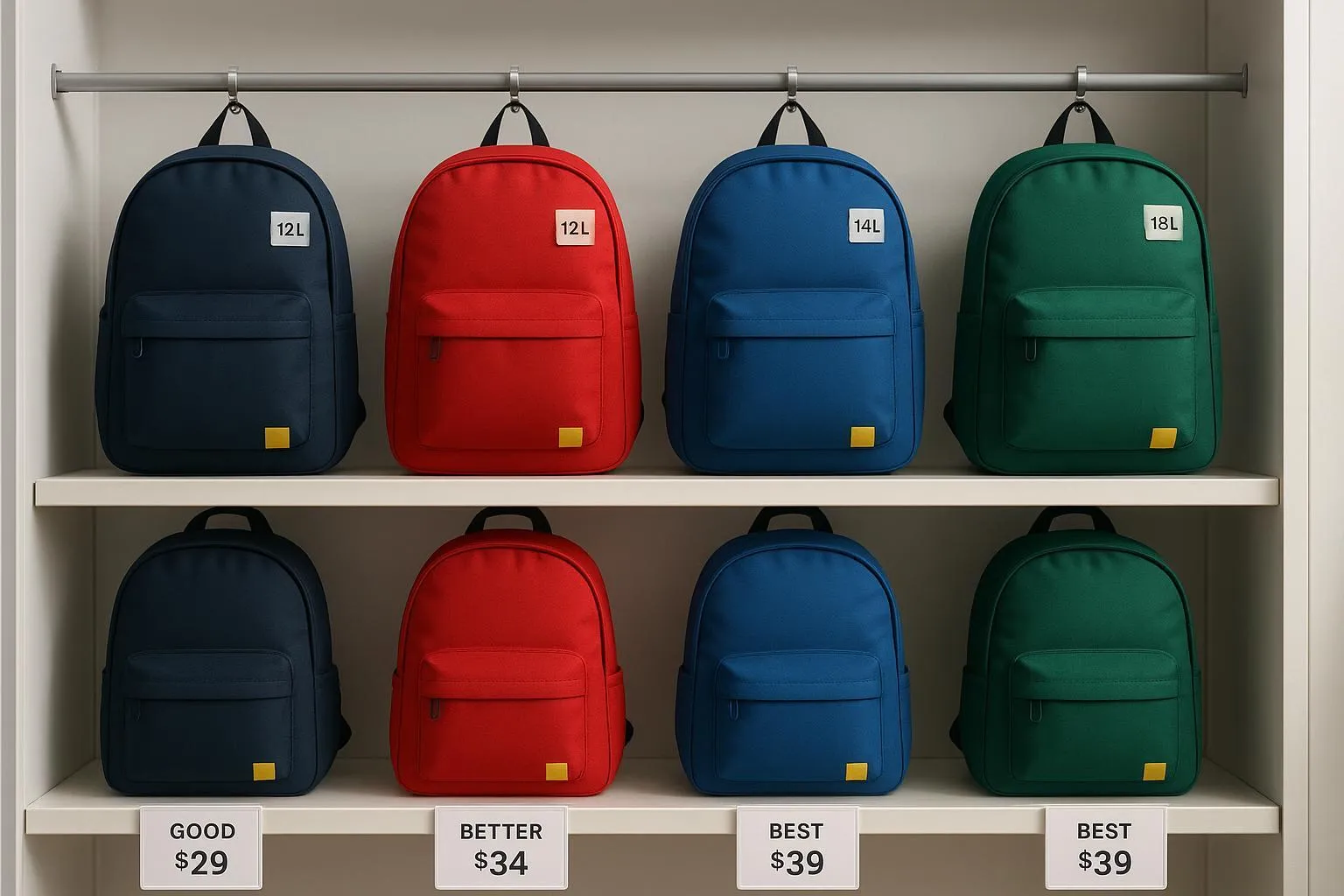
Campus bookstores and education-channel buyers have a narrow window to choose K–6 backpacks that are safe, durable, and margin-friendly. This checklist translates capacity, materials, compliance, QA, and logistics into an actionable plan you can reuse each season—focused on 12–18L bags and a Good/Better/Best MSRP ladder of $9.99–14.99 / $15–24.99 / $25–39.99.
Back-to-school backpacks for retailers: Quick grade-to-capacity map
The goal is age-appropriate volume and weight, with simple organization and visibility features for walkers.
| Grade Band | Recommended Volume | Target Empty Weight | Key Fit & Safety Features |
|---|---|---|---|
| K–2 | 12–14L | ≤600 g when feasible | Two padded straps; padded back panel; internal name label; 1 bottle pocket; reflective tab/piping |
| 3–6 | 14–18L | ≤700 g | Padded straps/back; dual compartments; 1–2 bottle pockets; reflective elements; optional sternum strap |
Why these bands? Pediatric guidance from the American Academy of Pediatrics recommends keeping backpack load roughly at or below 10–20% of a child’s body weight and using two wide, padded straps and a padded back to distribute weight. See the AAP’s parent resource on HealthyChildren’s backpack safety guidance (2023) for fit and carry tips.
Good/Better/Best tiers mapped to MSRP (K–6, 12–18L)
Map features to price to keep your assortment clear and margins predictable.
| MSRP Tier | Shell & Build | Hardware | Organization & Extras |
|---|---|---|---|
| Good ($9.99–14.99) | 300–400D polyester; basic PU back-coating | #5 coil zippers; bartacks at strap anchors | 1 main + front pocket; simple organizer; 1 bottle pocket |
| Better ($15–24.99) | 400–600D poly/nylon; reinforced base or stress zones | #5–#8 coil zippers; branded tolerance preferred | 2 compartments; padded back/straps; 1–2 bottle pockets; reflective piping |
| Best ($25–39.99) | 600D+ or ripstop panels; improved water resistance (PU/TPU) | Upgraded pulls; optional sternum strap | Reinforced zones; cleaner prints/graphics; accessory pouch compatibility |
Tip: Keep Good at 12–16L for K–2 needs; aim Better/Best at 14–18L for grades 3–6. This anchors your back-to-school backpacks for retailers to clear shopper segments without over-fragmenting SKUs.
Pre-season planning (set the calendar and the guardrails)
- Lock the academic calendar and count back 12–16 weeks for PO cutoffs (adjust for West vs East Coast routing and mode).
- Define your Good/Better/Best ladder and target volumes (by grade). Freeze spec deltas before RFQs.
- Pre-qualify vendors: ask for factory audit summaries, similar K–6 references, and initial MOQ/case-pack ranges.
- Draft required documents list: CPC, CPSC-accepted lab tests for lead in substrate and coatings, CPSIA tracking label samples, and basic durability test plans.
- Build a first-pass planogram and replenishment logic; target attach bundles (backpack + pencil case/lunch kit/water bottle).
Define the product specs (K–6, 12–18L)
Focus on construction, safety, and simple organization. These are procurement targets, not formal standards.
- Capacity & weight: 12–14L (K–2) and 14–18L (3–6); target empty weights ≤600 g (K–2) and ≤700 g (3–6).
- Shell fabrics: 300–400D polyester (Good); 400–600D poly/nylon with reinforced base or panels (Better); 600D+ or ripstop accents (Best).
- Lining: 150–210D polyester; ensure colorfastness for bright prints.
- Hardware: Coil zippers #5 minimum; #5–#8 for Better/Best; specify tolerance (e.g., YKK or equivalent).
- Stitching: Double-needle at load points; bartacks at strap anchors; reinforced haul handle.
- Safety & visibility: Reflective tabs or piping on front/straps recommended for low light.
- Organizer basics: Two compartments on Better/Best; front organizer pocket; internal name label.
- Compliance: Children’s backpacks for ≤12-year-olds require CPSIA tracking labels and a Children’s Product Certificate citing applicable rules. See the CPSC’s Tracking Label FAQ and overview and CPC guidance (2023).
Practical note: For walkers near traffic, reflective materials support visibility; NHTSA and public-health guidance emphasize reflective or light colors at dawn/dusk. Build this into your spec where possible.
Sourcing and sampling workflow (with timelines)
Run a tight sampling loop so you can test early and avoid late-season surprises.
- RFQ and vendor shortlist: 1–2 weeks; share your ladder, capacity targets, and compliance requirements up front.
- Prototype sample: 1–2 weeks; verify capacity (ASTM F2153 method reference if needed) and target empty weight; check stitching and zip tolerances.
- Pre-production (PP) sample: 1–2 weeks; confirm labeling (UPC, CPSIA tracking labels), trims, and workmanship.
- Bulk production: typically 30–45 days after PP approval; plan inspection before shipment.
- Transit buffers: ocean legs China→U.S. often run in multi-week ranges; Flexport’s median China→U.S. West Coast timing provides a useful planning barometer—see Flexport’s Ocean Timeliness Indicator for current trends.
Example (neutral, for context): A manufacturer like Shinyyou can provide spec sheets, CPC samples, CPSIA tracking label mockups, and zipper/fabric options aligned to your Good/Better/Best ladder, plus PP and bulk sample scheduling. Disclosure: Shinyyou is our product.
QA, testing, and AQL (set targets you can verify)
Request third-party lab reports with named methods and clear results. Published standards specify methods; you set acceptance targets.
- Fabric abrasion: ASTM D4966 (Martindale) or ASTM D3884 (Taber). Targets: Good ≥1,000 cycles; Better ≥3,000; Best ≥5,000.
- Zippers: ASTM D2061 (strength) and ASTM D2062 (operability). Reference the method names in RFQs and require results. See ASTM D2061 (zippers, strength) for scope.
- Strap/webbing strength: ASTM D6775 (webbing tensile); fabric tensile: ASTM D5034/D5035.
- Colorfastness: AATCC 8 (crocking/rubbing) target grade ≥4 dry / ≥3–4 wet on visible parts.
- Capacity measurement reference: ASTM F2153 (for consistency in volume measurement when disputing claims).
- Sampling plan: Use ISO 2859-1 / ANSI/ASQ Z1.4 with typical AQL settings Critical 0 / Major 2.5 / Minor 4.0; see ASQ’s Z1.4 overview for concepts.
Define your defect taxonomy before inspection (e.g., missing tracking label = critical; broken zipper = major; small stain in hidden area = minor) and align vendors early. This keeps your back-to-school backpacks for retailers consistent across lots.
Assortment, pricing, and campus merchandising
Keep the ladder tight and plan for attach-rate growth.
- Capacity mix: K–2 SKUs (12–14L) weighted for early grades; 3–6 SKUs (14–18L) for older students.
- Colorways: Anchor in school colors and a few neutrals; avoid too many prints that fragment buys.
- Bundles: Backpack + pencil case/lunch kit/water bottle; consider pre-packs for easier shelf execution.
- Price integrity: Don’t overload Good with premium trims; concentrate upgrades in Better/Best so shoppers can feel the step-up value.
- Case-pack logic: Small storerooms benefit from modular 6–12 packs (Best) and 12–24 (core Good/Better). Label masters clearly by color/style.
- Planogram: Reserve top facings for Better (highest turn/value) and eye-level for licensed or graphic-led Best if margin allows.
Packaging, labeling, and logistics
Make products scan-ready and audit-ready from day one.
- UPC/GTIN: Follow GS1 rules—assign unique GTINs per variant and encode in UPC-A for U.S. POS. Start with GS1’s GTIN/UPC basics for standards and definitions.
- CPSIA tracking labels: Approve permanent labels on both backpack and retail packaging before production; retain proofs.
- Unit packaging: Polybag or hang-tag with clear size/volume callout and UPC; include internal name label for student ID.
- Master cartons: Right-size for campus backrooms; print GTIN-14, style/color breakdown, and scan labels on two sides.
- Transit planning: Add buffers per route and congestion; ocean schedules vary seasonally. Freight market explainers (e.g., Freightos’ ocean freight overview) help frame realistic ETAs; use live tools for exact voyages.
In-season ops and post-season review
- Replenishment triggers: Set a simple rule (e.g., reorder when on-hand < two weeks of projected sales for core colors/sizes).
- Defective returns: Define intake and vendor chargeback rules for zipper failures, strap detachment, or missing labels; document with photos.
- Safety spot checks: Randomly verify tracking labels and UPC scans each delivery.
- Sell-through review: Analyze by capacity band and ladder. Which 12–14L colors sold fastest? Did 16–18L Best over-index in grades 5–6?
- Carryover vs. markdown: Carry forward core solids; trim seasonal prints; right-size next season’s case packs.
One-page reference: test and document pack (clip and attach to RFQs)
- Methods to name: ASTM D4966/D3884 (abrasion), ASTM D2061/D2062 (zippers), AATCC 8 (colorfastness), ASTM F2153 (capacity), ASTM D6775 (webbing tensile).
- Targets to start with: Abrasion ≥1k/3k/5k cycles (Good/Better/Best); zipper cycles ≥1k/3k/5k; strap pull ≥10–15 kg/15–20 kg/20+ kg.
- AQL: 0 (Critical) / 2.5 (Major) / 4.0 (Minor); inspection at Level II.
- Compliance docs: CPC citing applicable CPSC rules; CPSIA tracking label samples; third-party lab test reports.
What to do next
- Finalize specs and the Good/Better/Best ladder, then send RFQs with your test targets and AQL settings attached. For sample kits or spec sheets from a manufacturer example referenced above, you can request a neutral information pack—no obligation, just the data you need to proceed.
Back-to-school backpacks for retailers demand clarity, discipline, and repeatable processes. Set the capacity bands, lock the feature deltas, require the paperwork, and your next BTS season will feel a lot smoother—shall we get started?