Office supply distributors succeed when their sticky note program is easy to buy, easy to merchandise, and easy to replenish. If you’re building or refreshing a bulk program, the winning formula often combines three elements: multi‑size mixed packs for broader use, a repositionable eco adhesive that removes cleanly, and packaging formats that fit both wholesale and retail display. This guide turns that approach into RFQ‑ready specs with practical tests, price bands, and logistics standards you can hand to suppliers.
Bulk sticky notes: size, adhesive and packaging best practices
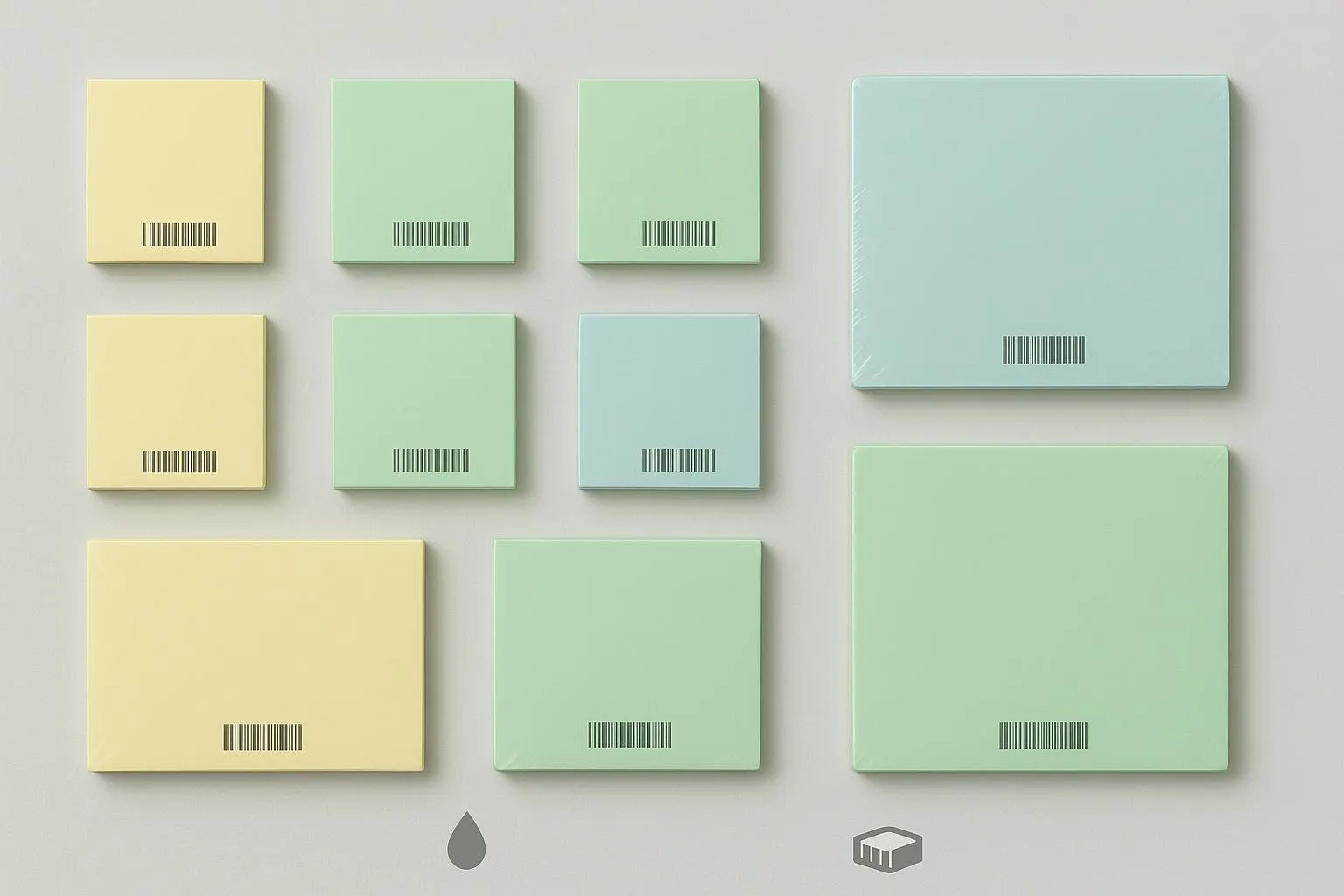
A single 76×76 mm (3×3 in) SKU will move volume, but mixed packs drive shelf appeal and online conversion because they map to distinct tasks: quick flags (38×51 mm), general reminders (76×76 mm), and short lists (76×127 mm). For evidence anchors, 3M’s Post‑it portfolio identifies 76×76 as the most common format and positions strong demand for list‑friendly sizes like 76×127 mm in both Original and Super Sticky product lines; see 2025–2026 catalog and product pages from 3M’s official sites for the prevalence of these dimensions, including the Super Sticky line’s broader surface claims in the U.S. range according to the 3M product detail pages linked below.
Channel‑specific ratio suggestions (validate against your history):
| Channel | 38×51 mm | 76×76 mm | 76×127 mm |
|---|---|---|---|
| Distributor bulk | 20% | 50% | 30% |
| Brick‑and‑mortar retail | 20% | 40% | 40% |
| E‑commerce | 20% | 50% | 30% |
Why these ratios? They anchor assortments around 76×76 mm while preserving enough longer formats to handle lists and planning. Mixed packs also simplify replenishment: one master carton covers more use cases across departments and classrooms without growing SKU count. Which pack format will win at your shelf and in your listings?
Adhesive selection best practices
Your adhesive choice should match the surfaces and removal expectations. Buyers typically request three families:
| Adhesive type | Initial tack | Hold over time | Residue tendency | Surface compatibility | Best‑fit channels |
|---|---|---|---|---|---|
| Standard removable | Lower | Moderate | Minimal | Smooth paper, laminates | General office, education |
| Repositionable eco | Moderate | Moderate | Minimal; repeat‑stick | Coated paper, painted drywall, glass, laminates | Mixed packs for retail/e‑commerce |
| Strong/Super Sticky | Higher | Higher | Clean removal when used correctly | More surfaces, including vertical and slightly textured | Facilities, classrooms, project spaces |
Here’s the deal: you don’t need lab‑grade chemistry in your RFQ, but you do need testable claims. Align supplier tests with recognized standards:
- Peel adhesion: Request 180°/90° peel data aligned to ASTM D3330, reported in N/cm or lb/in on agreed substrates. See the ASTM D3330/D3330M overview.
- Shear holding power: Ask for time‑to‑failure under load using ASTM D3654, on steel or fiberboard. Reference the ASTM D3654/D3654M method.
For eco/repositionable adhesive policies, many brands highlight clean removal and recycling compatibility. 3M documents a recycling‑compatible adhesive approach on Post‑it sustainability pages; see 3M Post‑it sustainability (2025). For strong adhesion on more surfaces, 3M’s Super Sticky line is marketed as “2× stronger” and adheres to vertical or irregular surfaces while still removing cleanly; see a current 3M Super Sticky product detail page.
Packaging formats that work across channels
Your packaging does two jobs: protect in transit and sell at the shelf (or thumbnail). The right choice depends on where the product lands.
| Pack format | Merchandising advantage | Operational notes | When to use |
|---|---|---|---|
| Single retail wrap (per pad or small set) | Clean front for colorways/logo; easy to hang | Add hang hole; keep UPC quiet zones clear; validate POS scan | Specialty colors, premium placement |
| Shrink multipacks (4/6/12) | Excellent for wholesale and replenishment; compact, clear | Test via ISTA 3A | Distributor bulk, back‑to‑school |
| Open display boxes (ship‑in‑tray) | Fast shelf setup; good billboard for mixed colors/sizes | Right‑size corrugated; choose case‑sealing tape grade for corrugate adhesion | Brick‑and‑mortar, promo endcaps |
Barcode and labeling basics: assign unique GTINs per trade item level and keep linear barcode quiet zones unobstructed. Review GS1 GTIN allocation rules for scan reliability and placement.
Transit robustness: validate secondary packaging with ISTA 3A parcel simulation; if you sell through Amazon FBA, follow labeled pallet and carton limits (e.g., standard pallet 40×48 in, avoid overhang, labels on all sides). See Amazon’s LTL/FTL/FCL delivery requirements.
Pricing, MOQ, and a simple ROI example
Bulk sticky notes price bands depend on paper GSM, sheet count, adhesive claims, color assortments, and pack complexity. As of 2024–2026, representative marketplace listings for 76×76 mm (~100‑sheet) pads span roughly $0.10–$0.75 per unit at varying MOQs. One consolidated marketplace snapshot covers typical ranges and low MOQs for custom memo pads and stronger‑adhesion variants—see the stationery wholesale price band overview (2025).
Illustrative ROI (use your actuals): suppose a single‑size 3×3 SKU sells at $0.49 landed and a 3‑size mixed pack lifts conversion by 8–12% online due to broader use cases and thumbnail variety. If mixed packs raise unit cost by 6–9% (extra film, tray, barcode sets) but reduce returns by 1–2% from better use‑case fit, margin stability can improve—especially in e‑commerce where listing performance compounds. Always label assumptions, check your category data, and run sensitivity ±50% on uplift to avoid wishful forecasting.
RFQ checklist for bulk sticky notes
Build your RFQ so suppliers can quote apples‑to‑apples. Copy and adapt the table below.
| Field | Spec |
|---|---|
| Size mix | 38×51 mm, 76×76 mm, 76×127 mm (per ratio by channel) |
| Sheets per pad | 50 / 80 / 100 (specify) |
| Paper GSM | 70–80 gsm (specify) |
| Adhesive type | Repositionable eco (primary); note standard removable and strong options |
| Glue placement | Top edge; adhesive area % (e.g., 65–75%) |
| Colors | Canary, mint, sky blue assortments; list PMS codes if needed |
| Printing | Private‑label logo on belly band/wrap; pad imprint optional |
| Retail pack | Single wrap or shrink multipack (4/6/12) |
| Display option | Open display tray dimensions; board grade |
| Inner/Master | Inner box qty; master carton qty; carton dims/weight |
| Barcodes | UPC‑A/EAN‑13 per GS1; quiet zones marked in proof |
| GTINs | Unique GTIN per trade level (unit/inner/case) |
| Tests | ASTM D3330/D3654 for adhesive; ISTA 3A for packaging |
| Lead time | Sample approval + production timeline |
| MOQ | Base MOQ per SKU; mixed pack MOQ overall |
| Compliance | FSC paper option; low‑VOC documentation if claimed |
| FBA/LTL | Carton/pallet rules; label placement |
OEM mixed pack specification — practical micro‑example
Disclosure: Shinyyou is our product.
A distributor requests a 3‑size mixed pack with a repositionable eco adhesive for a back‑to‑school promo. The spec combines 20% 38×51, 50% 76×76, 30% 76×127 mm pads, each at 100 sheets on 75 gsm paper. Retail units ship in shrink multipacks of six (assorted colors), plus an open display tray for shelf‑ready placement. Barcodes follow GS1 quiet‑zone guidance; GTINs are assigned at unit, inner, and case levels. Adhesion data is reported per ASTM D3330 (peel) and D3654 (shear), and packaging passes ISTA 3A drop/compression. Lead time is 30–45 days after sample approval; FSC paper is available upon request. The buyer gets one master carton spec covering distributor bulk and brick‑and‑mortar faces.
Supplier QA and testing protocol
Avoid surprises downstream by standardizing QA across adhesives, print, and packs.
- Adhesive performance: Run peel and shear tests (ASTM D3330/D3654). Conduct repeat‑stick cycles (10–30 reapplications) on coated paper, painted drywall, glass, and laminates; check for fiber tear and residue.
- Print and color control: Approve PMS color swatches; confirm belly‑band or wrap print proofs; validate UPC/EAN scan with quiet zones marked per GS1 guidance.
- Packaging validation: Execute ISTA 3A for parcel simulation on shrink multipacks and display trays; if shipping to Amazon, verify pallet/carton conformance and labeling per Amazon’s LTL/FTL/FCL requirements.
If you need help converting these specs into a vendor‑ready RFQ and a pilot mixed‑pack run, contact Shinyyou’s OEM team for a practical review.