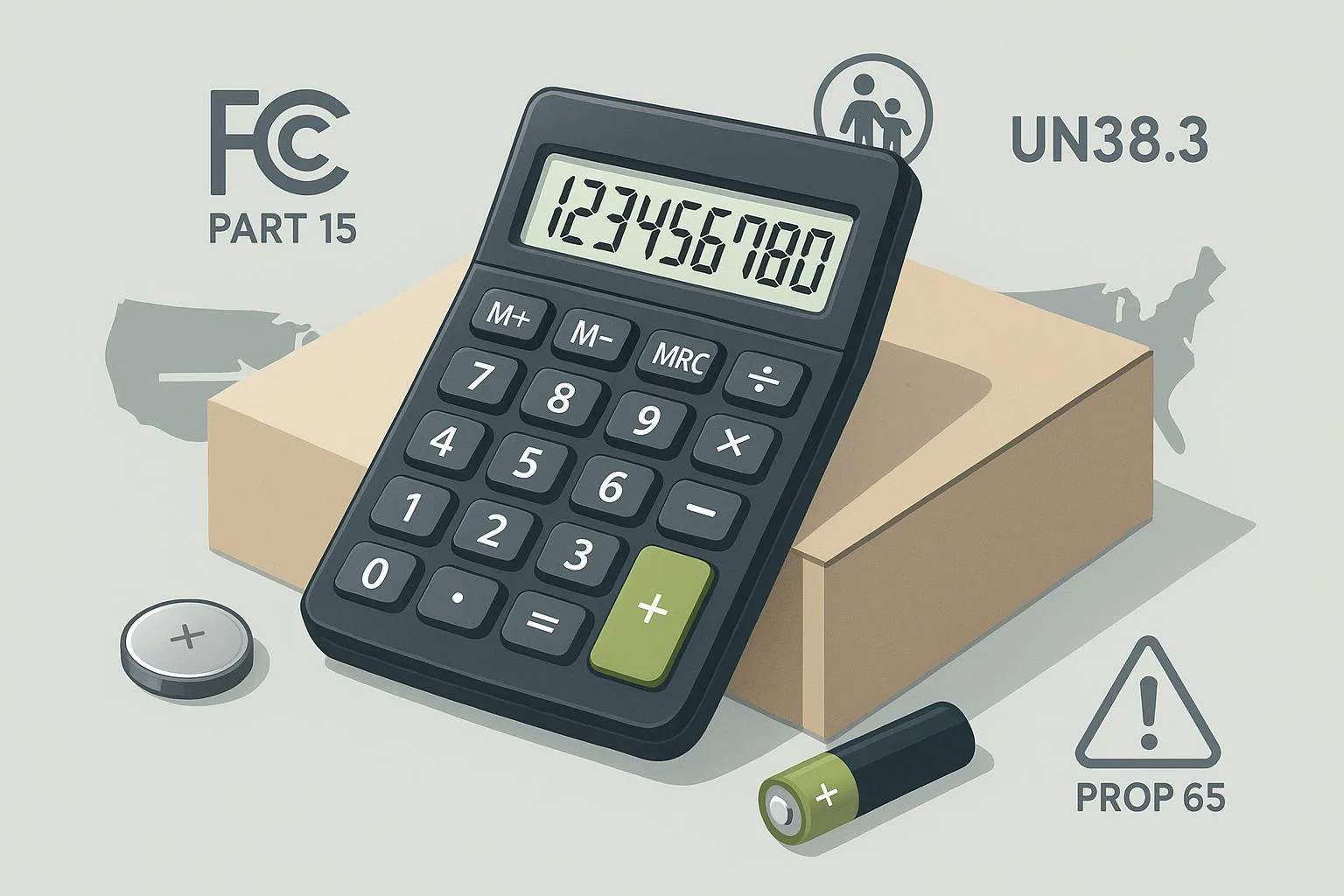
If you’re sourcing pocket or promotional calculators from China for the U.S. market, three checkpoints will make or break your launch: display readability, battery choice and safety, and U.S. compliance files. This guide translates engineer-speak and legal text into buyer-ready specs, artwork notes, and supplier requests—tailored to the search intent behind calculator wholesale China.
Who this guide is for—and what’s inside
This guide serves U.S.-based importers, retailers, promo distributors, and e‑commerce sellers buying pocket calculators in bulk. You’ll get practical display specs you can drop into RFQs, battery options with safety and logistics implications, a U.S. regulatory checklist with label text tied to CFR sections, what to ask suppliers (SDoC, UN38.3, CPC, COO, Prop 65), and a final FAQ and glossary so your team speaks the same language.
Pocket calculator types and common use cases
Pocket/promotional calculators typically come as slim 8–12‑digit units (sometimes with a flip cover) for giveaways and school kits, credit‑card formats with membrane keys for ultra‑low power use, and mini‑desktop styles with larger keys and angled displays for office bundles. They’re simple number crunchers, not scientific or printing devices—so your spec focus is readability, runtime, and compliant labeling that clears U.S. checks.
Lock your display specifications for calculator wholesale China
Readable displays reduce returns and bad reviews. Decide these essentials up front and write them into drawings and RFQs.
Digit height (mm): For handheld viewing at ~20–40 cm, 8–10 mm digits are a sweet spot; 6–8 mm suits ultra‑compact frames; 12 mm improves legibility for mini desktops. Example LCD modules list explicit heights—Varitronix’s VT620‑001 specifies 9.0 mm character height (reflective TN). See the manufacturer datasheet for exact specs.
Varitronix VT620‑001 (9.0 mm): https://www.varitronix.com/files/datasheets/VT620-001.pdf
LCD technology:
TN: lowest cost; narrow viewing cone.
HTN: better contrast and angles than TN; common in budget models.
STN: best contrast/angles for reflective segments; slightly slower response and higher cost.
Optical mode:
Reflective (most promo units): excellent daylight legibility, ultra‑low power.
Transflective: allows backlight at added power draw; reflective contrast slightly lower.
Viewing orientation: Specify preferred “o’clock” viewing for peak contrast (e.g., 6 o’clock when viewed from below on a desk).
Temperature notes: LCDs darken and respond slowly in cold; add a low‑temp readability requirement if your audience includes outdoor or warehouse users.
Display spec snapshot
Item | Best‑practice buyer note |
|---|---|
Digit height | ≥8 mm for handheld; 10–12 mm for easier reading |
Tech | HTN or STN for improved angles; TN if cost is king |
Mode | Reflective for promos; transflective only if backlight required |
Viewing | Define 6 o’clock or 12 o’clock orientation in RFQ |
Low‑temp | Add -10 °C readability note if relevant |
Cite a module datasheet in your RFQ so the factory matches the viewing cone and character height.
Power options and battery safety: LR44/AG13 vs. CR2032 vs. AAA
Your power choice affects compliance, runtime, and logistics.
LR44 / AG13 (alkaline button cell; ~1.5 V): Low cost, tiny footprint, suitable for ultra‑low‑power calculators. Typical capacities are on the order of ~110–170 mAh depending on load profile, per manufacturer application data. Reese’s Law applies because it’s a button cell.
Energizer Alkaline Application Manual (covers A76/LR44): https://data.energizer.com/pdfs/alkaline_appman.pdf
CR2032 (lithium coin cell; ~3.0 V): Higher voltage and capacity (~220–235 mAh typical per major brands). Great for long shelf life. Triggers lithium shipping rules and button/coin battery safety requirements.
Panasonic CR2032 datasheet (≈225 mAh typical): https://industrial.panasonic.com/cdbs/www-data/pdf2/AAA4000/AAA4000C321.pdf
AAA alkaline (1.5 V): Easier user replacement and long runtime (~1100–1250 mAh typical under light drains). Larger housing, but avoids lithium shipping constraints and button‑battery ingestion concerns.
Energizer Alkaline Application Manual (E92/AAA): https://data.energizer.com/pdfs/alkaline_appman.pdf
Simple comparison (choose based on use case)
Option | Nominal V | Typical capacity | Pros | Watch‑outs |
|---|---|---|---|---|
LR44/AG13 | 1.5 V | ~110–170 mAh | Tiny, low cost | Reese’s Law child‑safety + warnings |
CR2032 | 3.0 V | ~220–235 mAh | Long shelf life, stable | UN38.3/IATA shipping + ingestion hazard |
AAA alkaline | 1.5 V | ~1100–1250 mAh | Easy replace, long runtime | Larger size; packaging weight |
Tip: If you want to avoid lithium shipping paperwork altogether, spec AAA alkaline. If ultra‑slim is a must, weigh LR44 vs. CR2032 and plan for Reese’s Law and UN38.3/IATA obligations.
U.S. compliance and certifications checklist (with authoritative anchors)
This section maps the required or market‑expected items. Use it to build your document pack.
FCC — Unintentional radiators (no radio)
Framework: 47 CFR Part 15 Subpart B with Supplier’s Declaration of Conformity (SDoC) per 47 CFR §2.1077.
Label/statement: Devices must carry the Part 15 statement (on device and/or in the manual) per §15.19 and operate under §15.5 conditions. Emissions limits in §15.107 (conducted) and §15.109 (radiated).
Authoritative references: §15.19, §15.5, §15.107, §15.109, and §2.1077 on the eCFR.
Example text to include in your artwork/IFU (verify exact formatting against the latest eCFR):
“This device complies with Part 15 of the FCC Rules. Operation is subject to the following two conditions: (1) this device may not cause harmful interference, and (2) this device must accept any interference received, including interference that may cause undesired operation.” [47 CFR §15.19]
Reese’s Law — Button/coin batteries (16 CFR part 1263; incorporates UL 4200A‑2023)
Triggers: Any consumer product with button/coin batteries (e.g., LR44/AG13, CR2032).
Requirements: Child‑resistant battery compartments; ingestion‑hazard warnings on product/packaging/instructions; child‑resistant packaging for loose spares (16 CFR part 1700). Third‑party testing if the product is a children’s product.
CPSC guidance and effective date summaries are publicly available.
CPSIA — Only if the calculator is a children’s product (≤12 years)
Requirements can include: total lead in substrate ≤100 ppm (15 U.S.C. §1278a); lead in paint ≤90 ppm (16 CFR part 1303); small parts (16 CFR part 1501) for under‑3s; tracking labels; testing by CPSC‑accepted labs per 16 CFR part 1112; Children’s Product Certificate (CPC).
CBP Country‑of‑Origin marking — 19 CFR part 134
“Made in China” must be legible, conspicuous, and as permanent as practicable for the ultimate purchaser; packaging marks can apply when product marking is impracticable.
California Proposition 65 — Article 6 safe harbor warnings
If exposure exceeds safe harbor levels, provide warnings that meet Article 6. The 2025 short‑form amendments require at least one listed chemical name in the short‑form warning, with a transition period through 2027–12–31.
Keep links to authoritative sources in your internal worksheet so your team can verify the latest text:
FCC Part 15 and §2.1077 (eCFR): https://www.ecfr.gov/current/title-47/chapter-I/subchapter-A/part-15 and https://www.ecfr.gov/current/title-47/chapter-I/subchapter-A/part-2/subpart-J/section-2.1077
CPSC Reese’s Law FAQs and dates: https://www.cpsc.gov/FAQ/Button-Cell-and-Coin-Battery-FAQs
CPSIA lead limits (overview): https://www.cpsc.gov/FAQ/Total-Lead-Content and 16 CFR part 1303: https://www.ecfr.gov/current/title-16/chapter-II/subchapter-B/part-1303
CBP COO marking (19 CFR part 134): https://www.ecfr.gov/current/title-19/chapter-I/part-134
OEHHA Prop 65 rulemaking: https://oehha.ca.gov/proposition-65/crnr/proposition-65-clear-and-reasonable-warnings-safe-harbor-methods-and-content
Packaging, labeling, and artwork files your factory should prepare
Give your supplier a single artwork pack and file‑naming convention so nothing gets lost. Include:
FCC: The §15.19 statement (device label or user manual) and SDoC compliance information per §2.1077 (responsible party name, address, and contact included with the product documentation).
Reese’s Law: On‑product and packaging ingestion‑hazard warnings; proof that the compartment meets UL 4200A‑2023; child‑resistant packaging spec if loose batteries are included.
CPSIA (if a children’s product): CPC listing each applicable rule; CPSC‑accepted lab reports; tracking labels on product/packaging.
COO marking: “Made in China” location on the article or packaging with a photo proof.
Prop 65 (if used): Updated short‑form safe harbor wording with at least one listed chemical name; ensure online product pages mirror the on‑package warning language.
If you need help generating compliant packaging files (dielines, label placements, and print‑ready warnings), many OEM partners can support artwork preparation and coordinate third‑party testing as requested. For example, see Custom Printing Services for packaging artwork support: https://stationerysolution.com/custom-printing-services/
Logistics and shipping notes for lithium coin cells
If your SKU uses a lithium coin cell (e.g., CR2032):
UN38.3: The cell type must have a UN38.3 test summary available from the manufacturer/distributor.
IATA DGR: When cells are “contained in equipment,” shipments typically fall under UN3091 and follow PI 969; “packed with equipment” typically follows PI 970. Check quantity limits, packaging, and marks per the IATA Lithium Battery Guidance.
Stability: Confirm no significant design changes from the tested cell; otherwise, a new test summary may be needed.
Authoritative resources to retain in your shipping SOP:
IATA Lithium Battery Guidance 2026: https://www.iata.org/contentassets/05e6d8742b0047259bf3a700bc9d42b9/lithium-battery-guidance-document.pdf
UN Manual of Tests and Criteria Rev.8 hub (Section 38.3): https://unece.org/transport/dangerous-goods/rev8-files
Supplier vetting and what to ask manufacturers
Use this as a sourcing email or RFQ checklist:
FCC SDoC info per §2.1077 and the latest EMC test report against §15.107/§15.109 (Class B).
Button/coin battery dossier (if applicable): confirmation of UL 4200A‑2023 design compliance, the exact warning statements for product/packaging/instructions, and child‑resistant packaging details for loose batteries.
Lithium transport pack (if CR2032): UN38.3 test summary for the specific cell model; IATA DGR PI confirmation (969/970) for your packing method.
COO marking proof: artwork and photo showing “Made in China” position/size.
Prop 65: exposure assessment summary or final safe harbor warning artwork (if used) reflecting the 2025 short‑form update.
If intended for children ≤12: CPC with CPSC‑accepted lab reports and tracking label samples.
Neutral example of supplier capability context
Some OEM partners can support packaging files, private‑label artwork, QC documentation routing, and coordination with third‑party labs. For instance, Shinyyou offers OEM/private‑label support for stationery and related products and can coordinate packaging and labeling deliverables as part of an order when requested. For QC process context, see Quality Control Standards: https://stationerysolution.com/quality-control-standards/
Inbound QC acceptance ideas (keep it lightweight for promos): function (key press registration; no stuck segments), display (digit height meets spec; viewing angle matches drawing), power (battery type/polarity; compartment latch integrity/child‑resistant features if applicable), and labels (FCC statement; COO mark; warnings match proofs).
Mini case scenarios (what goes wrong—and how importers fixed it)
Missing FCC SDoC details at inbound
Problem: Retailer’s QA noticed devices had no visible Part 15 statement and no SDoC paperwork in the master pack.
Fix: Supplier added the §15.19 text to the IFU and provided SDoC info per §2.1077 with a U.S. responsible party; rework labels before retail release.
No UN38.3 summary for CR2032
Problem: Freight forwarder flagged a shipment with lithium coin cells; no UN38.3 test summary for the exact cell model.
Fix: Importer obtained the manufacturer’s UN38.3 test summary and added it to the shipper’s pack; updated the SOP to verify cell model/version at PO placement.
Prop 65 short‑form not updated
Problem: California channel partner required the new short‑form warning including a chemical name; artwork still used the pre‑amendment format.
Fix: Team revised packaging to include at least one listed chemical in the short‑form; updated e‑commerce PDP warnings to match.
FAQ
Do pocket calculators require FCC certification?
They’re unintentional radiators under Part 15 Subpart B and typically use the SDoC route (no certification grantee code). You must include the §15.19 statement and meet §15.107/§15.109 limits. See the eCFR for §2.1077 details.
When does Reese’s Law apply to calculators?
If the product contains button or coin batteries (LR44/AG13, CR2032). It mandates child‑resistant compartments, specific warnings on product/packaging/instructions, and child‑resistant packaging for loose batteries.
Do I need UN38.3 for shipping calculators with CR2032?
Yes. The coin cell type must have a UN38.3 test summary. Air shipments follow IATA DGR rules for UN3091 under PI 969 (contained) or PI 970 (packed with equipment).
What if my calculator is marketed to children under 12?
You’ll need a CPC listing applicable CPSC rules (lead, paint, small parts, etc.), with testing by a CPSC‑accepted lab and tracking labels on product/packaging.
What digit height should I specify?
For everyday pocket use, ≥8 mm is common. Consider 10–12 mm if you want easier reading. Cite a module datasheet to lock it in.
Glossary
SDoC (Supplier’s Declaration of Conformity): An FCC conformity pathway where the responsible party (often the importer/distributor) ensures and declares that the product meets applicable rules and provides contact information with the device documentation (47 CFR §2.1077).
Unintentional Radiator: A device that generates RF energy within a circuit but isn’t designed to emit RF intentionally; evaluated under Part 15 Subpart B.
Class B Limits: Emissions limits in §15.107 (conducted) and §15.109 (radiated) intended for residential environments.
UL 4200A‑2023: Safety standard for products that contain button or coin batteries; incorporated by reference into 16 CFR part 1263 for Reese’s Law compliance.
UN38.3 Test Summary: A standardized summary proving a lithium cell/battery type has passed safety tests outlined in the UN Manual of Tests and Criteria, Section 38.3; must be available from the manufacturer/distributor.
PI 969 / PI 970: IATA Dangerous Goods Regulations packing instructions for lithium metal batteries “contained in equipment” (PI 969) and “packed with equipment” (PI 970) under UN3091.
Tracking Labels: CPSIA identifiers on children’s products/packaging to enable traceability (manufacturer/importer, date, batch).
Prop 65 Short‑Form Warning: A California safe harbor label format that, after the 2025 update, requires naming at least one listed chemical in the short‑form text, with a transition period through end of 2027.
By aligning display readability, choosing the right power strategy, and securing the U.S. compliance pack early, you’ll keep schedules and margins intact—without surprises at the border or on the shelf. If you’re starting an RFQ today for calculator wholesale China, here’s the deal: pick the digit height, pick the battery, paste the label text, and ask for the test reports. Then move to samples and artwork proofs with your supplier.