Corporate gifting lives or dies on credibility. If you’re handing employees or clients a “sustainable” notebook, it needs to withstand scrutiny from procurement, compliance, and sustainability teams. This guide gives you a practical, defensible way to specify eco-friendly notebooks—starting with paper and verified labels—so your claims hold up when someone asks, “Can you show me the documents?”
You’ll learn exactly what the FSC labels really mean, how recycled-content claims should be documented, what ink and adhesive choices support environmental goals, and how to package gifts with integrity. You’ll also get a ready-to-copy specification and a concise document pack request so you can brief suppliers with confidence.
What “FSC certified notebooks” really means
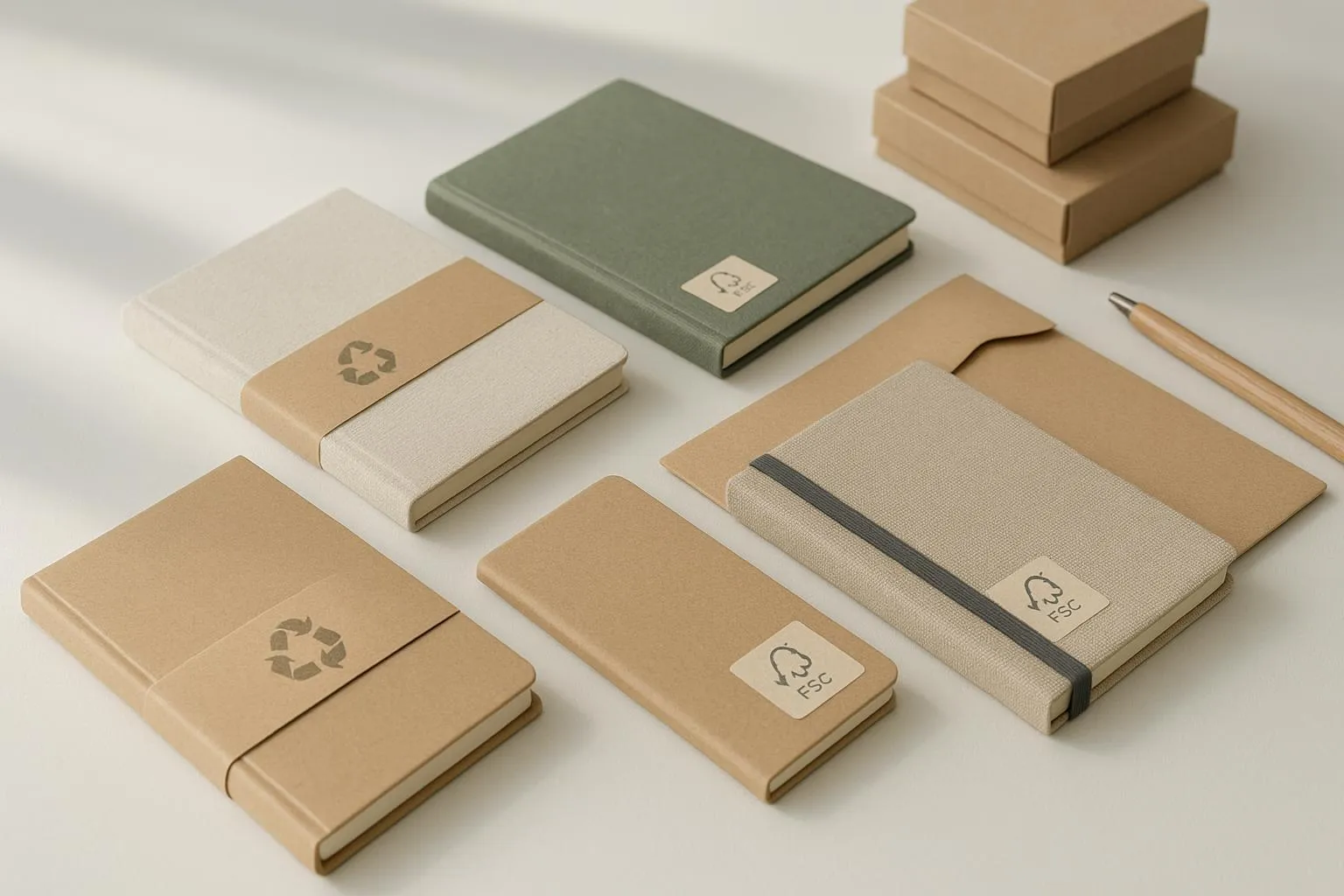
“FSC certified notebooks” signals that the paper content is tied to the Forest Stewardship Council’s Chain of Custody (CoC) and that on-product labeling rules are followed. But there isn’t just one label—there are three, and each tells a different story about the material mix:
| FSC label | What it means | When it fits | Verification tip |
|---|---|---|---|
| FSC 100% | All virgin fiber comes from FSC-certified forests. | Premium gifting where you want virgin fiber performance with full forest certification. | Ensure your supplier holds an active CoC and that the on-product label aligns with 100% claims. See the label taxonomy and Controlled Wood context in the FSC overview. |
| FSC Mix | A mix of FSC-certified material, controlled wood, and/or reclaimed material. | The most common, balancing availability, price, and responsibility. | Match actual material flows to the label type your supplier generates via the FSC trademark portal. |
| FSC Recycled | Made entirely from reclaimed (reused or recycled) material. | Strongest recycled signal; may have different print/texture characteristics. | Confirm chain-of-custody and that the label displayed is “FSC Recycled,” not just a generic recycled claim. |
For authoritative interpretations of labels and Controlled Wood context, see the official FSC overview of Mix/Controlled Wood and labels in the page titled “Controlled Wood.” FSC provides a step-by-step tutorial for certificate holders on how to generate and download on-product labels through its trademark portal, which is where the exact label artwork and text come from.
- Label meanings and Controlled Wood context: see FSC’s explanation in the Controlled Wood area of its site: FSC Mix label and Controlled Wood overview.
- How labels are created by certificate holders: FSC’s on-product label generation tutorial.
In practice, a valid “FSC certified notebooks” claim requires that every company in the chain, from mill to converter to your supplier, is covered by CoC audits. If the chain breaks, the on-product claim isn’t compliant. See FSC’s CoC guidance and explanatory notes confirming chain-wide auditing for labeled products: FSC news on new Chain of Custody directives and an explanatory UK resource: What is FSC? (notes, Aug 2024).
A quick regulatory note: FSC has indicated that products labeled “FSC Recycled” are outside the virgin-material deforestation scope of the EU Deforestation Regulation. See the factsheet: FSC EUDR Factsheet.
Recycled content and GRS: when and how it applies
FSC covers paper fiber sourcing and traceability. If your notebook uses recycled textiles or polymer components—think elastic closures, fabric covers, pen loops—the Global Recycled Standard (GRS) can document recycled content outside the paper stream. Under GRS, recycled content is stated as a precise percentage, and that percentage is backed by chain-of-custody documents:
- A Scope Certificate indicates that a facility is certified under GRS to handle recycled materials within defined processes.
- A Transaction Certificate (TC) is issued for shipments, connecting the recycled content claims to specific purchase orders and lots.
Textile Exchange maintains public documentation for GRS v4.0 and related guidance:
- Program and documents overview: Textile Exchange standards hub.
- Guide to recycled materials (GRS-202): GRS-202 Guide to Recycled Materials.
- Policy for Transaction Certificates (ASR-104): ASR-104 Policy for Transaction Certificates.
Two practical takeaways for corporate notebook programs:
- If you claim recycled content in elastic bands or fabric covers, ask your supplier to provide the GRS Scope Certificate and TCs for those components. The percent must be explicit and consistent with GRS rules.
- Align your on-product messaging with what GRS allows for the final product and components. Final-product labeling under GRS follows eligibility rules—verify against the most recent Textile Exchange policies before you approve artwork.
Inks, adhesives, and binding choices that back your sustainability claim
Paper is only part of the story. Printing systems, adhesives, and binding methods can strengthen or weaken environmental performance and recyclability.
- Inks: Favor low-VOC systems commonly used on paper such as water-based flexo/gravure and vegetable-based (e.g., soy) offset inks. Request supplier statements on de-inkability and compliance with recognized exclusion policies for hazardous substances. When your notebooks are used in settings that require it, ask for documentation relevant to food-contact-adjacent safety or indoor emissions.
- Adhesives: Water-based PVA or starch adhesives are standard in bookbinding and often align well with recyclability targets. Request Safety Data Sheets (SDS) and declarations addressing REACH and Proposition 65 assessments. Ensure adhesives match the binding type (e.g., case-bound, perfect bound) to avoid durability trade-offs that lead to early disposal.
- Binding & finishing: Wire-o and spiral bindings introduce metal or plastic; if you choose them for function, specify easy separation for recycling. For case-bound or perfect-bound notebooks, use FSC-certified cover boards with paper wraps. Aqueous coatings typically reduce solvent exposure versus traditional varnishes and can support recyclability better than heavy plastic laminates.
Here’s the deal: you don’t need to name every chemical. You do need supplier documentation that demonstrates the materials and processes meet your compliance and recyclability intent.
Covers and finishing: eco options without hurting printability
High-recycled content papers can have lower brightness or a textured feel. That’s not a flaw; it’s a look—and it often telegraphs sustainability at first glance. If your brand identity leans toward crisp photographic reproduction or vivid spot colors, consider:
Favor FSC Recycled or FSC Mix interior stocks in the 80–120 gsm range for smooth writing and minimal show-through. Use FSC-certified boards for hard covers and pair them with unlaminated or lightly coated paper wraps. When you need scuff resistance, try aqueous coatings before reaching for plastic laminates. If you do apply films, specify minimal thickness and ensure your supplier can explain end-of-life instructions (e.g., remove elastic/metal parts, recycle paper body).
Think of it this way: finish choices are a dial, not a switch. You can nudge aesthetics and durability while staying aligned with eco goals by preferring paper-first solutions and only adding films where they add clear value.
Packaging options that stand up to scrutiny
Your sustainability story can unravel at the packaging table. Favor paper-first, clearly labeled solutions and reserve compostability marks for certified configurations.
For compostability in the EU, industrial compostability is defined by EN 13432 criteria (disintegration, biodegradability, heavy metals, eco-toxicity). Certification marks like “Seedling” or “OK compost INDUSTRIAL” are granted only when the exact packaging specification—material, thickness, inks, adhesives—passes accredited testing. For official context, see European Bioplastics’ factsheets and Seedling scheme guide: European Bioplastics factsheets on standards and Seedling Certification Scheme; and TÜV AUSTRIA’s program pages for OK compost and Seedling. In the US, environmental marketing claims such as “recyclable” or “compostable” must be substantiated; see the FTC’s guidance hub: FTC environmental marketing guidance.
How to buy FSC certified notebooks with confidence: compliance by market
Different markets have different rules. Here’s a compact view of touchpoints you should expect in EU and US programs when purchasing FSC certified notebooks:
EU focus
- REACH Article 33 requires suppliers to communicate if any SVHC on the Candidate List is present at more than 0.1% w/w in an article and provide safe-use information. Check the ECHA Candidate List and Article 33 guidance; evaluate SCIP database relevance.
- If your notebooks are marketed to or intended for children, consider EN 71-3 (migration of certain elements). The latest amendment EN 71-3:2019+A2:2024 is summarized by testing bodies; see SGS overview of A2:2024.
US focus
- For children’s products, the CPSIA requires a Children’s Product Certificate (CPC) based on testing by a CPSC-accepted lab; see CPSC CPC overview and CPSC lab search.
- California’s Proposition 65 safe-harbor warnings have updated short-form rules; see OEHHA update page for the latest.
- For environmental claims in the US, ensure “recyclable/compostable” substantiation per the FTC Green Guides hub.
Procurement toolkit: a ready-to-copy specification and document request
Copy these blocks into your RFQ or PO so the supplier knows exactly what to deliver.
Specification (paste into your RFQ)
Notebook format: A5 case-bound, 192 pages.
Interior pages: 90 gsm uncoated, FSC Recycled or FSC Mix (specify). Opacity and whiteness per mill data.
Cover board: FSC-certified board with paper wrap; aqueous coating preferred; no plastic laminate unless specified.
Printing inks: Water-based flexo/gravure or vegetable-based offset inks; supplier to provide de-inkability and exclusion-policy compliance statements.
Adhesives: Water-based PVA or starch; SDS and REACH/Prop 65 assessment required.
Elastic/fabric components (if any): Recycled content disclosed as exact percentage; provide GRS Scope Certificate and Transaction Certificates.
Packaging: Paper belly band or sleeve; master cartons recyclable (PAP 20/21). Compostable mailers only if certified; include certification ID and logo use approval.
On-product claims: FSC label type must match material flow; labels generated in FSC trademark portal.
Document pack request (attach to PO)
- FSC Chain of Custody certificate number and trademark license code; sample of on-product label artwork used for this job; if relevant, see FSC’s tutorial on label generation: FSC on-product label tutorial.
- For any recycled textile/polymer components: GRS Scope Certificate and corresponding Transaction Certificates showing exact % recycled content; verify policy basis at ASR-104 Policy for Transaction Certificates.
- SDS for inks and adhesives; declarations of compliance with relevant exclusion policies and REACH; Prop 65 assessment where applicable.
- EU, if in scope: SVHC declaration per REACH Article 33 guidance; SCIP status; EN 71-3 report (see SGS summary of EN 71-3:2019+A2:2024).
- US, if in scope: CPC and accredited lab test reports (per CPSC CPC overview; labs via CPSC lab search); Prop 65 safe-harbor assessment per OEHHA update.
- Environmental claims substantiation: recycling/composting access rationale; EN 13432 certificate IDs for any compostable packaging (see European Bioplastics factsheets); US marketing claims alignment per FTC environmental marketing guidance.
Supplier selection tips for sustainable notebook programs
Verification matters more than promises. Ask prospective suppliers to walk you through how they generate the exact FSC on-product label for your order and how they track recycled components with TCs. Probe how they decide between aqueous coatings and laminates—and how that affects recyclability in your markets.
Disclosure: Shinyyou is our product. In supplier comparisons, a partner like Shinyyou can support FSC-aligned paper choices and typical compliance document packs; equally, any capable OEM with valid FSC Chain of Custody and, where needed, GRS documentation can meet the same bar. Your selection criteria should emphasize certificate validity, document completeness, and clear guidance on claims and labeling.
A simple test: request a redacted example of an FSC label file generated from the trademark portal and a sample GRS TC. The quality of those two documents—and the confidence with which a supplier explains them—often predicts your downstream workload.
Short scenarios: three corporate-gifting briefs and how the spec changes
Scenario 1: 500 premium welcome kits for new executives
- Goal: Premium feel with verified sustainable sourcing and crisp branding.
- Spec moves: FSC 100% or FSC Mix interior for brightness; case-bound with aqueous-coated paper wrap; deboss/foil as needed; paper belly band.
- Docs: FSC label artwork, CoC details; REACH SVHC declaration; if shipped to California, Prop 65 assessment.
Scenario 2: 1,000 event notebooks for a sustainability summit
- Goal: Strong recycled signal and low-plastic packaging.
- Spec moves: FSC Recycled interior and cover board; unlaminated wrap with aqueous coating; elastic band with declared recycled percentage and GRS documentation.
- Docs: FSC Recycled label proof; GRS Scope/TCs for elastic; FTC-ready language on recyclability/compostability; EN 13432 certificate ID for any certified compostable mailers used.
Scenario 3: 2,500 employee gifts including a children’s subset
- Goal: Broad corporate distribution with a kids’ activity variant.
- Spec moves: FSC Mix interiors with smooth writing surface; sturdy paper-first packaging; consider wire-o for the kids’ variant.
- Docs: For the children’s variant—CPC with lab reports; EN 71-3 test results per current harmonized standard; Prop 65 assessment for California shipments; REACH SVHC declaration for EU distribution.
Final word
If you remember one thing, make it this: pair every sustainability claim with the exact document that proves it. Do that, and your “FSC certified notebooks” program will be easy to defend—and appreciated by everyone from legal to the end recipient. Now, copy the spec block above, add your logo guidelines, and send it to short-listed suppliers. Let’s make sustainable gifts that stand up to real-world questions.