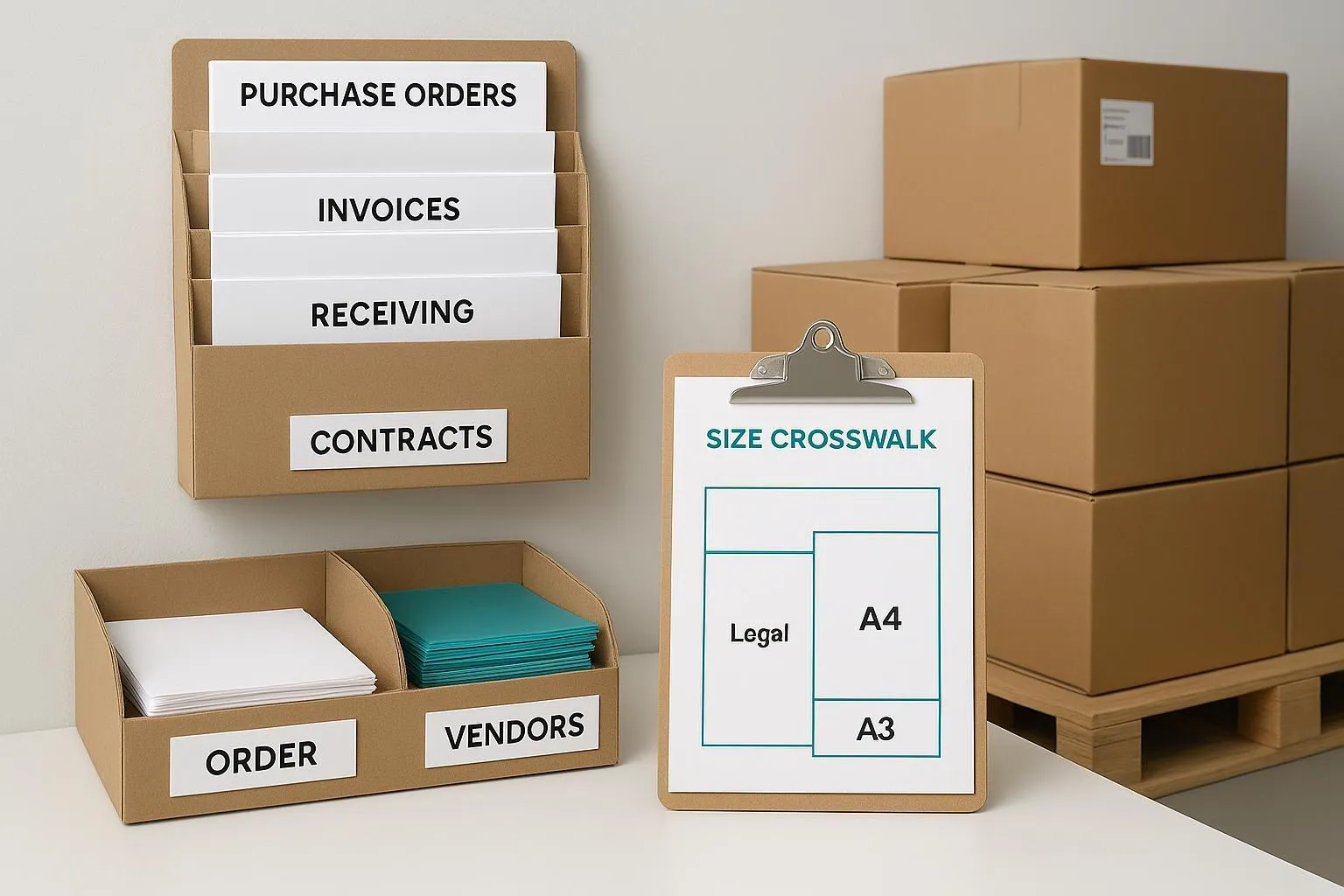
If you’re building a paper organizers wholesale assortment for K–12 classrooms or SMB offices, you need more than product photos. You need a clear size‑compatibility map across Letter/Legal and A4/A3, guidance on slot counts and label windows, optional durability targets, and packaging specs that move cleanly through 3PLs and retailer compliance checks. This distributor‑first guide gives you the matrices, specs, and checklists to issue RFQs, compare suppliers, and land inventory that fits and ships the first time.
Size standards and organizer compatibility
Classrooms and offices around the world standardize on two families: North American inch‑based sizes (Letter, Legal, Tabloid) and the ISO 216 A‑series (A4, A3). The differences are small on paper, but they drive real fit issues in trays and cubbies.
- Letter is slightly wider and shorter than A4, so a tight A4 tray can make Letter feel stubby in depth while a snug Letter tray can pinch A4’s width. According to Microsoft’s guidance on default paper sizes and ISO references summarized by Adobe (updated 2025–2026), A4 measures 210 × 297 mm while US Letter is 216 × 279 mm; Legal is 216 × 356 mm; Tabloid is 279 × 432 mm. See the background overviews in Microsoft’s paper size page and Adobe’s ISO 216 explainers for A4/A3 and the A‑series scaling.
Compatibility at a glance:
| Sheet/Use Case | Nominal Size (in) | Nominal Size (mm) | Typical Organizer Fit Notes |
|---|---|---|---|
| US Letter | 8.5 × 11.0 | 216 × 279 | Fits dedicated Letter trays; fits many A4 trays but will be ~18 mm shorter; allow slot depth ≥ 12.0 in for tabs. |
| US Legal | 8.5 × 14.0 | 216 × 356 | Requires deeper slots (≥ 14.5 in recommended) and often taller label windows for visibility. |
| Tabloid/Ledger | 11.0 × 17.0 | 279 × 432 | Aligns closely to ISO A3 organizers; requires oversized desktop or dedicated cubbies. |
| ISO A4 | 8.27 × 11.69 | 210 × 297 | Fits A4 trays; in Letter trays, width can be tight; depth must be ≥ 12.0 in for tabs. |
| ISO A3 | 11.69 × 16.54 | 297 × 420 | Often served by Tabloid‑sized organizers; confirm internal width clearance ≥ 12.0 in. |
| Art paper (oversize) | 12 × 18 | 305 × 457 | Needs dedicated construction‑paper storage; slot internal dims ≥ 12.5 × 18.5 in recommended. |
Notes for distributors:
- Maintain slot depth clearance beyond paper length for label tabs and dividers (0.5–1.0 in extra is a practical target).
- For mixed‑market assortments, mark A4‑only units clearly and provide Letter fit notes to reduce returns.
- ISO A‑series scales by a √2 ratio; halving A3 yields two A4 sheets with the same proportions, which helps when planning multi‑size art storage. Adobe’s ISO 216 articles explain this scaling in plain language (2025–2026 updates).
Desktop, wall‑mount, and drawer units
Form factor drives both fit and throughput. Desktop literature sorters for classrooms commonly offer 10–15 “mailbox” slots, while office units range from compact 7‑slot sorters to 36‑slot modules.
- Classroom exemplars: Pacon’s Classroom Keepers series lists cubby units sized for student mail or construction paper; retailer specs show slot depths around 12.5 in for standard paper and up to ~18.5 in for 12 × 18 art stock (2024–2026 product pages).
- Office exemplars: Compact desktop sorters with ~7 slots handle letters, invoices, and envelopes; plastic or fiberboard bodies are typical at this size.
Recommended distributor spec targets:
- Internal slot width: 9.0–9.5 in for Letter/A4; 12.0–12.5 in for Tabloid/A3; 12.5–12.8 in for 12 × 18 art.
- Internal slot depth: ≥ 12.0 in for Letter/A4; ≥ 14.5 in for Legal; ≥ 17.5 in for Tabloid/A3.
- Label windows: 20–30 mm tall with matte cover; ensure contrast for barcode or alphanumeric labels when needed.
- Modular options: Consider stackable or wall‑mount variants for space‑constrained classrooms and admin offices.
Materials, finishes, and when strength ratings matter
Most paper organizers are corrugated or fiberboard. Suppliers seldom publish numeric board ratings for desk organizers, but you can still set optional targets when environments are rougher (district mailrooms, high‑traffic art rooms).
- Optional corrugated targets: For added durability, ask for single‑wall board meeting roughly 26–32 ECT (edge crush) or ~200# burst (Mullen). Industry explainers in 2025–2026 note ECT is the better predictor of stacking performance for cases, while Mullen relates to puncture/burst resistance. Request supplier test reports when numeric claims appear.
- Moisture and abrasion: Specify a moisture‑resistant or laminated finish for art rooms and areas with frequent cleaning.
- Handling and storage: The Fibre Box Association’s storage/handling bulletins emphasize conditioning to room humidity, avoiding edge crushing, and protecting flutes—simple practices that maintain performance before assembly (2018 guidance, still current in 2025–2026 reference sets).
What to include in your RFQ for paper organizers wholesale
Use this RFQ field set to compare paper organizers wholesale offers apples‑to‑apples across suppliers.
| Category | Field | Buyer Guidance |
|---|---|---|
| Compatibility | Target paper sizes | Letter, Legal, Tabloid; A4, A3; call out 12 × 18 art if needed. |
| Form factor | Unit type | Desktop, wall‑mount, drawer; note stackable or modular. |
| Capacity | Slot count | Typical classroom: 10–15; office: 7–36. State tolerance on count and on‑time fill. |
| Fit | Internal slot dims | Width × Depth × Height per slot; include min depth for label tabs. |
| Labeling | Label window | Height in mm (20–30 mm typical), cover type, color options. |
| Materials | Board and finish | Corrugated/fiberboard; recycled content claim and finish (matte/laminated/moisture‑resistant). |
| Optional strength | ECT or Mullen | If required, specify target (e.g., ≥ 26 ECT or ~200# burst) and test report format. |
| Packaging | Inner/master pack | Units per inner and master; flat‑pack vs assembled; include hardware if wall‑mount. |
| Case data | Case dims and GW | External L × W × H; gross weight target; stacking limits in storage. |
| Palletization | TI × HI | Target cases per layer and layers per pallet; total cases/pallet. |
| Identification | Barcode symbology | ITF‑14 for GTIN‑14 on corrugated cases, or GS1‑128 when variable data is needed. |
| Identification | GTIN‑14 and SSCC | Provide GTIN‑14 for cases; confirm SSCC creation for logistic units. |
| Compliance | Certifications and chemicals | FSC/SFI/PEFC CoC option, REACH (EU‑bound), Prop 65 review (US‑CA). |
| Retailer | ASN/labeling program | If shipping to specific retailers, attach the latest routing/packaging mandates. |
Cartonization, TI × HI, and safe handling for paper organizers wholesale
The right pack plan cuts freight cost and damages. Decide first whether to ship flat‑pack (lowest cube, assembly at destination) or assembled (higher protection, higher cube). Then publish case and pallet attributes so your DC and customers can plan receiving.
- Manual handling: NIOSH’s Revised Lifting Equation supports a 51 lb (≈ 23 kg) baseline under ideal conditions; realistic site multipliers often reduce that. Many distributors target ≤ 22–23 kg per case for routine manual handling. State your target and stay consistent.
- TI × HI calculation: Total cases per pallet equals cases per layer (TI) multiplied by layers (HI). Keep pallet heights compatible with dock doors, racking, and stretch‑wrap limits.
Example pallet math:
| Pallet Attribute | Example A (Flat‑pack) | Example B (Assembled) |
|---|---|---|
| Case external (in) | 24.0 × 16.0 × 10.0 | 20.0 × 18.0 × 14.0 |
| Case gross weight | 17.5 lb | 21.0 lb |
| Pallet footprint | 48 × 40 in | 48 × 40 in |
| TI (cases/layer) | 10 | 8 |
| HI (layers) | 5 | 5 |
| Total cases/pallet | 50 | 40 |
| Est. pallet weight | 875 lb | 840 lb |
Tip: Validate compression and stability when stacking higher layers or when using flat‑pack configurations; simple case compression checks help prevent unit‑load collapse.
Case and pallet labels that scan the first time
GS1 standards keep cases moving. Use the correct symbology and place labels where scanners can find them quickly.
- ITF‑14 encodes only the GTIN‑14 and is well‑suited for corrugated case identification and direct‑to‑corrugate printing. GS1 US guidance (2025) recommends bearer bars and adequate quiet zones for reliable reads.
- GS1‑128 carries variable data like SSCC, lot, and dates. For logistic units, include the SSCC as Application Identifier (00). The GS1 General Specifications (2025–2026 editions) detail character sets, HRI, and placement.
- Placement norms: A 4 × 6 in case label with the barcode baseline roughly 32 mm from the bottom edge and at least 19 mm from vertical edges is widely accepted in North America; place pallet transport labels on two adjacent sides at a band roughly 400–800 mm from the floor.
Quick setup list:
- Assign GTIN‑14s to saleable cases; print ITF‑14 where only the GTIN is needed.
- Generate SSCCs for every logistic unit; encode as AI (00) in GS1‑128 and match to your ASN.
- Verify print contrast and quiet zones; test with the same scanner model your DC uses.
Chain‑of‑custody, REACH, and Prop 65
Sustainability and chemical compliance differ by destination market and customer policy. Ask suppliers for documentation up front to avoid surprises.
- Chain‑of‑custody: Offer FSC, SFI, or PEFC options when buyers require certified fiber or recycled claims. Major mills publish certificate coverage; International Paper’s public certificates hub is a representative example reviewed by procurement teams in 2025–2026.
- EU REACH: If shipping to the EU, confirm coatings, inks, and adhesives comply with REACH obligations and that any SVHC content is disclosed per Article 33. The European Commission’s REACH portal (2026) lays out current roles and duties.
- California Proposition 65: For US shipments into California, check whether any listed substances in inks/adhesives/labels trigger warnings under OEHHA’s “clear and reasonable warnings” regulations (2025–2026 versions). Coordinate wording and placement early if required.
Three fast distributor scenarios
Scenario 1: K–12 classroom mailboxes
- Assortment: Two desktop units per classroom, 12–15 slots each, Letter/A4 compatible.
- Pack plan: Flat‑pack; inner 5 pcs, master 20 pcs; case GW ≤ 40 lb; TI × HI = 10 × 5 → 50 cases/pallet.
- Labeling: ITF‑14 on cases, SSCC on pallet labels; ASN shares GTIN‑14 and SSCC.
Scenario 2: SMB office admin set
- Assortment: 7‑slot desktop sorters for incoming mail and invoices; a small wall‑mount for shared docs.
- Pack plan: Assembled for “put to use” readiness; inner 4 pcs, master 16 pcs; GW ≤ 46 lb; TI × HI = 8 × 5 → 40.
- Labeling: GS1‑128 case label with lot/date for programs that require it; otherwise ITF‑14 is sufficient.
Scenario 3: Art room oversize storage
- Assortment: Construction‑paper cubbies for 12 × 18 sheets; moisture‑resistant finish.
- Pack plan: Flat‑pack with reinforced corners; inner 2 pcs, master 8 pcs; GW ≤ 42 lb; TI × HI = 6 × 6 → 36.
- Labeling: ITF‑14 case ID; pallet transport labels on two sides with SSCC.
Simple tests before you scale an order
- Slot‑fit check using actual Letter, Legal, A4, A3, and 12 × 18 sheets with label tabs inserted.
- Case compression and stack test for your chosen TI × HI; confirm wrap tension and corner protection.
- Humidity exposure check for laminated vs uncoated finishes.
- Label scannability QA against GS1 rules: verify quiet zones, contrast, and SSCC/ASN match.
Handy conversions and sources
Conversions you’ll use often:
- 1 in = 25.4 mm; 0.5 in ≈ 12.7 mm; 1.0 in ≈ 25.4 mm.
- Letter 8.5 × 11 in = 216 × 279 mm; Legal 8.5 × 14 in = 216 × 356 mm; Tabloid 11 × 17 in = 279 × 432 mm.
- A4 210 × 297 mm; A3 297 × 420 mm.
Further reading and standards referenced in this guide:
- Microsoft’s overview of default paper sizes in software and locales (2025): the publisher’s globalization paper size page clarifies regional defaults and common formats. Microsoft globalization paper size
- Adobe’s A‑series explainers (2025–2026): plain‑language summaries of ISO 216 and A3/A4 dimensions and scaling. Adobe guide to paper sizes
- Fibre Box Association storage/handling bulletin and handbook index (2018; cited in 2025–2026 packaging practice): preservation of corrugated strength in storage/handling. Fibre Box Handbook overview
- GS1 US symbology overviews (2025): ITF‑14 for corrugated case IDs and GS1‑128 for variable logistics data including SSCC. GS1 US on GS1‑128 and GS1 US on ITF‑14
- GS1 General Specifications transport label placement (2025–2026): baseline rules including SSCC structure and case/pallet label positions. GS1 General Specifications
- NIOSH Revised Lifting Equation overview (2026): baseline 51 lb reference and ergonomics context. NIOSH RNLE
- European Commission REACH portal (2026): obligations for inks/adhesives/coatings and SVHC communication. EU REACH regulation overview
- OEHHA Prop 65 “clear and reasonable” warnings (2025–2026): current safe‑harbor content and methods. OEHHA Prop 65 warnings