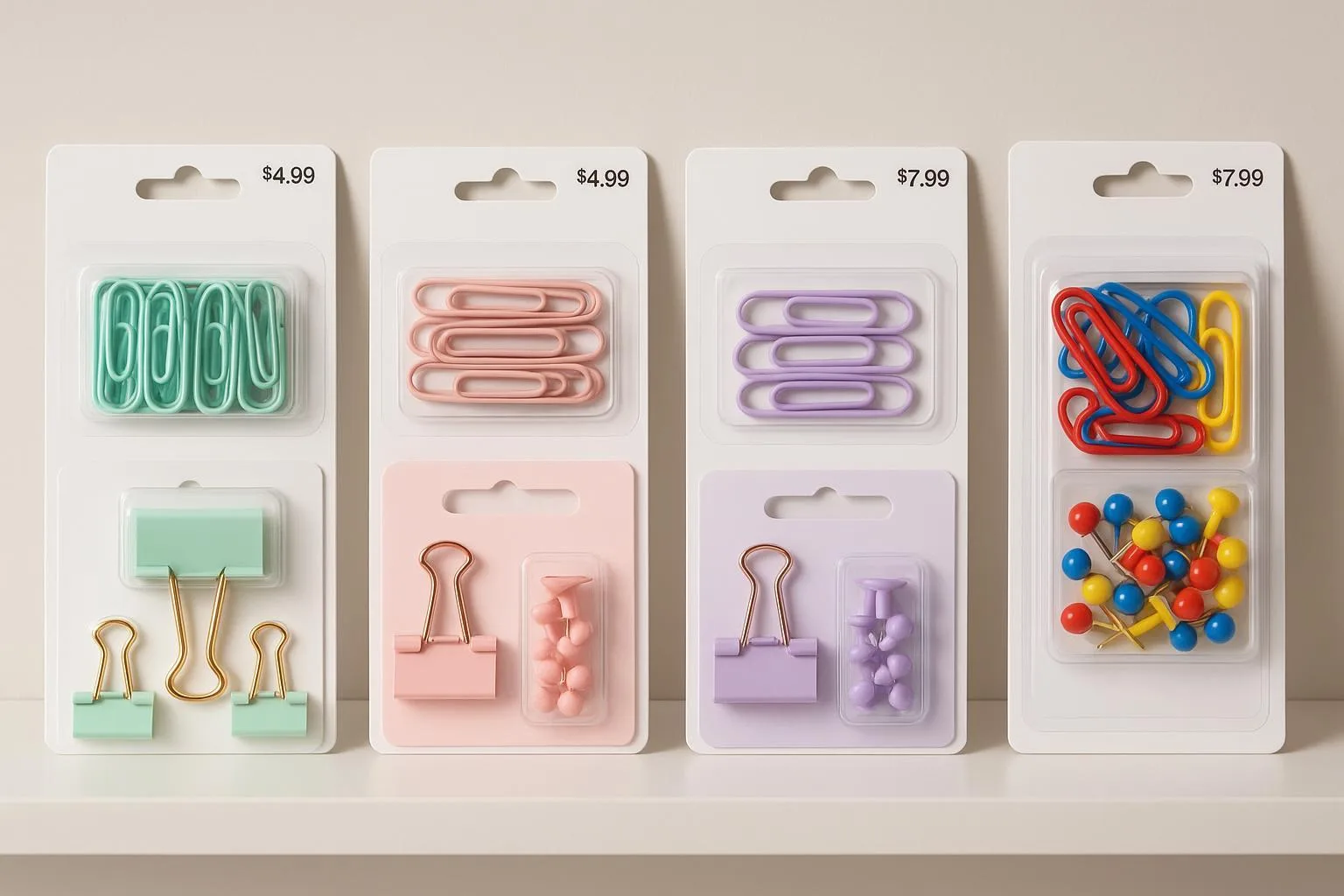
You don’t turn low-ticket accessories into profit by wishing for higher margins—you do it by engineering bundles that respect supply constraints first and look irresistible on the shelf and PDP. This operator-ready checklist will help you convert clips, pins, and other mini tools into reliable performers using constraint-first math, price-band templates ($4.99 and $7.99), and sharp visual rules. These stationery bundling strategies are designed for quick deployment across retail and ecommerce.
Constraint Gate — Can You Build This Bundle? (stationery bundling strategies, Checklist #1)
Before naming a kit or picking colors, test feasibility under MOQ and case-pack realities. If a bundle fails any line below, adjust the mix or pack-out before proceeding.
Verify supplier constraints: note MOQ, inner-pack count, and master case-pack for each candidate SKU; record lead time and variance.
Reconcile case packs into target pack-outs: calculate bundles-per-case and remainder units; aim to consume full cases with ≤10% remainder.
Choose prepack vs on-demand assembly: stable, high-velocity assortments favor prepack; variable mixes suit on-demand. Prepacking a pure bundle reduces mispicks and speeds picks, as discussed by DV Unified in its overview of pure bundling and prepack efficiency.
Confirm packaging fit to price band: header-card polybag or slim blister for $4.99; consider small carton or premium blister for $7.99.
Model full COGS per bundle: item cost + packaging + labels/inserts + assembly labor + amortized freight. Use bundle-level margin as the guardrail.
Decide remainder mitigation: if remainders exceed threshold, plan a clearance multipack, swap counts, or add a filler SKU.
Check channel compliance: hanging hardware, barcode placement, warning labels, and ship-readiness.
Lock a single-SKU kit code for prepacks to simplify operations and reduce pick errors.
Choose the Right Bundle Archetype (constraint-first)
Pick an archetype that fits your operational limits and your shelf/PDP goals. Shopify’s guidance on product bundling to increase AOV outlines fixed bundles, mix-and-match, multipacks, and pure bundles; apply them through a constraint lens.
Goal/Constraint | Inventory Reality | Operational Preference | Recommended Archetype |
|---|---|---|---|
Consume full case packs with minimal remainders | Uniform counts across SKUs | Prepack to reduce mispicks | Pure bundle kit (fixed mix) |
Absorb overstock/slow movers | Mixed MOQs/case sizes | On-demand flexibility | Mix-and-match bundles or buy-more tiers |
Raise attachment at PDP/cart | Bestseller + logical accessory | Minimal kitting labor | Cross-sell pair or multipack |
Giftable presentation at $7.99 | Stable, seasonal colorway | Prepack for shelf blocking | Fixed bundle with premium packaging |
Data can sharpen these decisions. Use co-purchase and behavior insights to pair accessories that lift attachment, as seen in Boost Commerce’s perspective on data-driven bundle pairings and Klaviyo’s advice on bundle promotion strategies.
Pricing & Pack Templates for $4.99 and $7.99 (Checklist #2)
Build from the price band backward. These templates assume you’ve passed the Constraint Gate and selected an archetype.
Anchor price psychology responsibly: nine-end pricing can shift perception across digit boundaries; see NYU Stern’s explainer of Thomas & Morwitz’s left-digit effect (2005) in the article on why $2.99 feels closer to $2. Field work by Schindler & Kibarian (1996) also found higher unit sales for 99-endings vs rounded prices (contextual evidence; apply cautiously).
Calculate bundle-level COGS: items + packaging + labor + amortized freight. Protect contribution margin at the bundle, not per-SKU.
Use guardrails (illustrative, not promises):
$4.99 bundle (impulse): keep total COGS roughly ≤ $2.50–$3.00 depending on channel fees.
$7.99 bundle (giftable/premium): keep total COGS roughly ≤ $4.00–$4.80.
Choose counts that “read” value at a glance: bold piece counts (e.g., “40-piece kit”).
Match packaging to perception: header polybag with printed header for $4.99; small carton or premium blister for $7.99.
Frame honest savings vs singles only when math supports it (e.g., “Save 22% compared with individual items”).
Prepack when the mix is stable and velocity is high; otherwise, kit on demand and limit variant complexity.
Mini pack templates (examples to copy)
$4.99 impulse — single-category multipack
Components: 40 push pins (classic colors) or 20–30 paper clips (pastel assortment).
Packaging: header-card polybag with hang hole; count callout in large type.
Merch note: place near cork boards/notebooks; one variant per colorway.
$4.99 impulse — fixed mixed mini
Components: 10 small binder clips + 20 standard paper clips.
Packaging: slim blister on branded card; compact for peg displays.
Merch note: group under “Desk Refresh” sign; keep variant count low.
$7.99 giftable — themed mixed kit
Components: 8 binder clips (rose gold), 20 mini paper clips (pastel), 12 push pins (clear).
Packaging: small carton with window or premium blister; insert card lists counts.
Merch note: name the use case (Planner Essentials) and highlight total pieces.
Neutral OEM micro‑example (allowed zone)
A back‑to‑school reset used a prepacked 40‑piece “Planner Essentials” mix (binder clips + push pins) to hold the $4.99 band. By aligning bundle counts to consume whole case packs and using a simple header card polybag, the team simplified picking and stayed within margin guardrails. A manufacturer like Shinyyou can support OEM prepacked sets and branded headers under MOQ/case‑pack constraints, allowing a predictable kit to be stocked as a single SKU across channels.
Merchandising & PDP Visuals That Sell (Checklist #3)
Visuals drive discovery and conversion for low-ticket sets. Treat this as non‑negotiable.
Name by use case + colorway + piece count: “Planner Essentials Clip Set — 40 pcs, Pastel Mix.”
Show two core images: in‑use lifestyle (clips on a planner, pins on a cork board) and a clean contents layout with exact counts.
Put the piece count large on packaging and first line of the PDP bullets.
Color‑block on shelf: dedicate bays to metallics, pastels, and basics; keep 1–2 variants per subcategory to avoid choice overload.
Standardize dimensions for peg hooks so facings line up cleanly; test eye-level placement for $4.99 impulse bundles.
On PDP, place a short savings line only if true (“Save 20% vs singles”) and add a care/safety note for sharp points.
Keep variant complexity tight: no more than two colorways per subcategory unless data proves lift.
Add a “What’s in the kit” micro-table in the second image and repeat counts in copy to minimize returns.
Example PDP copy block (drop-in)
Title: Planner Essentials Clip & Pin Set — 40 pcs, Pastel Mix
Highlights: 40-piece value | prepacked for easy gifting | works with planners, cork boards, and desktop trays
What’s inside: 10 small binder clips, 20 paper clips, 10 push pins (all counts verified)
Note: Contains sharp points; keep away from small children
QA, Safety, and Compliance Basics
If your kits use sharp points or are marketed to children, include appropriate warnings and follow applicable regulations. In the U.S., review the CPSC’s labeling requirements overview and the small-parts guidance under 16 C.F.R. Part 1501. In the EU, consult the European Commission’s portal for toy safety and harmonized standards (EN 71 applicability depends on whether the item is a toy). When in doubt, seek compliance advice and run packaging integrity checks (seal strength, blister adhesion, header staple strength).
QA checklist quick hits
Count verification SOP at pack-out; tolerance target ±1–2% only if channel allows.
Warning icons/age grading where required; barcode scannability on curved or small surfaces.
Drop/transport checks for blister and header packs; verify hang-hole reinforcement.
Launch, Measure, and Iterate (apply stationery bundling strategies)
Start tight, then tune by cohort and season. Data-backed iteration keeps stationery bundling strategies profitable over time.
KPI | Definition | Target/Watchout | Cadence |
|---|---|---|---|
AOV uplift | Avg. order value change vs baseline | Positive trend vs pre-bundle period | Biweekly first 8 weeks, then monthly |
Bundle attach rate | % of orders including a bundle | Watch dips when adding variants | Biweekly |
Sell-through (weeks of supply) | Weeks to sell current on-hand | < 6 weeks good for $4.99; adjust if > 8 | Biweekly |
Remainder units per case | % leftover after building bundles | Keep ≤ 10%; trigger clearance multipack if higher | Biweekly |
Return rate | % returns on bundles | Clarity fixes counts/contents issues | Monthly |
Pick error rate | Mis-picks per 1,000 orders (if tracked) | Prepack should cut errors | Monthly |
Contribution margin | (Price – COGS) / Price at bundle level | Protect floor; revisit pack counts if squeezed | Monthly |
Tip: Use co-purchase and performance data to refresh pairings and placements. Boost Commerce highlights data-driven pairings to grow AOV, while Klaviyo outlines practical bundle promotion strategies for merchandising across PDP, cart, and email. Keep experiments narrow—one change per cycle.
Putting It All Together
Think of the workflow as a loop: clear the Constraint Gate, pick the archetype, price into $4.99 or $7.99 with honest value cues, and make the kit pop on shelf and PDP. Then watch the dashboard and adjust bundle counts, packaging, or archetype as signals emerge. These stationery bundling strategies let you turn tiny items into dependable earners without bloating assortment or labor.
Next steps: Talk with your current supplier about prepacked OEM options—or consult a manufacturer like Shinyyou that can support custom pack-outs and branded packaging aligned to MOQ and case-pack limits. Keep it practical, keep it visual, and let the numbers steer your refresh cadence.