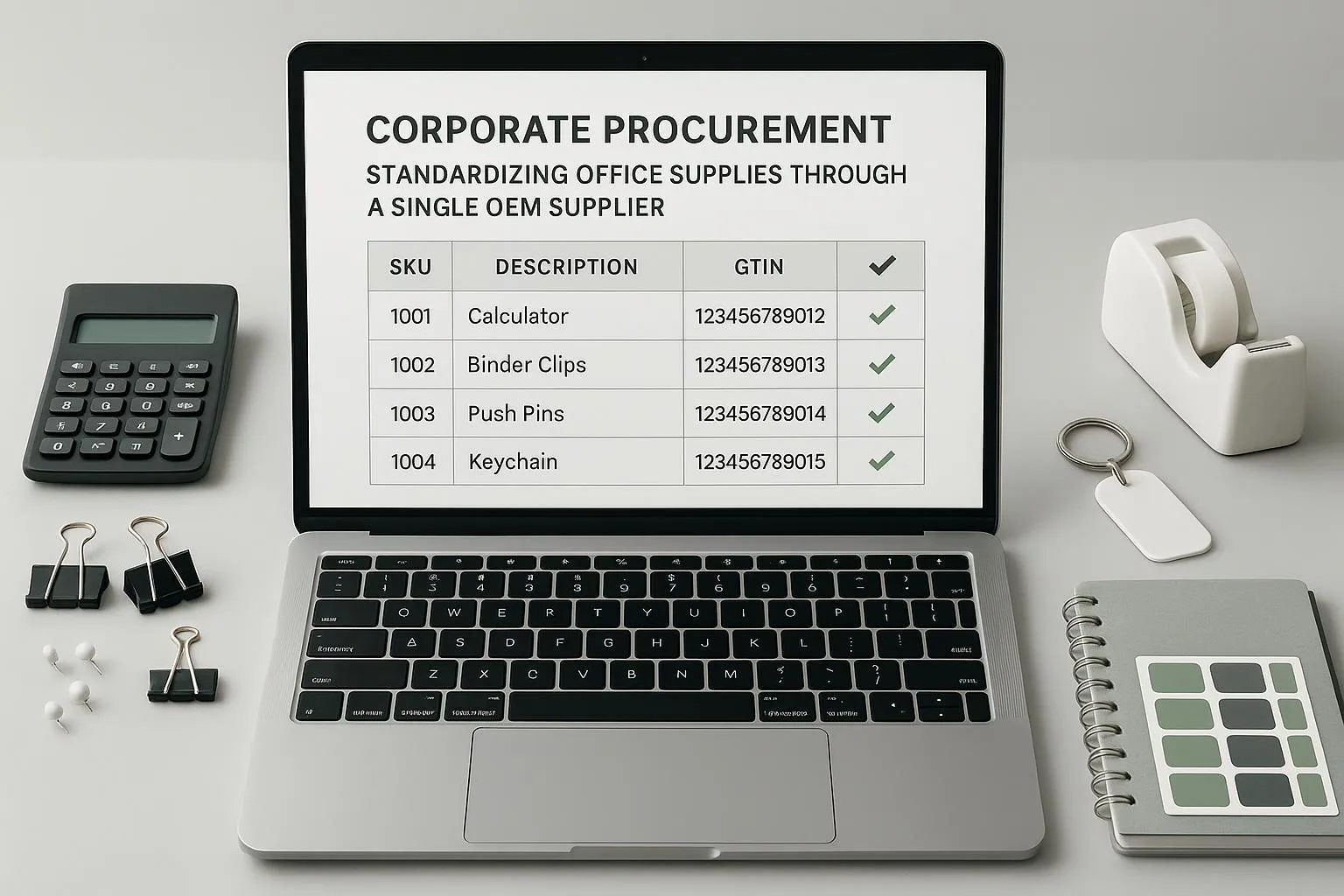
If your sites keep improvising when a staple runs out—swapping in whatever’s on a nearby marketplace—your catalog isn’t standardized; it’s fragile. This guide shows how to design and govern a procurement‑grade, standardized office supplies SKU list with a single OEM supplier so you cut stockouts and stop substitution chaos. You’ll get a copy‑ready SKU master schema, category playbooks for six must‑have areas, a single‑OEM integration roadmap with KPIs, and compliance checklists you can enforce tomorrow.
What “standardized” really means in office basics
Standardization is more than picking a favorite stapler. It’s a governed system that makes every record unambiguous and substitutable under rules you control. At minimum, your standardized office supplies SKU list should normalize:
Identifiers: Internal SKU, manufacturer and MPN, and GTIN/UPC/EAN across each/inner/case per GS1 packaging hierarchy (supports correct barcoding and receiving). See the GS1 Attribute Dictionary for Business for canonical identifier structures.
Taxonomy: A commodity code (e.g., UNSPSC) to enable clean analytics and sourcing roll‑ups—an MDM best practice highlighted in Verdantis’ procurement master data overview.
Specifications & materials: Structured attributes (dimensions, materials, functions) to end free‑text ambiguity; components/BOM links where relevant.
Pack & UOM: Base and order UOM, inner/case quantities aligned to GTINs.
Procurement parameters: MOQ and confirmed lead time captured in the master (see DirectSourcing’s item master attributes).
Compliance hooks: Category‑specific fields (FSC/PEFC for paper goods; REACH/RoHS for electronics‑adjacent items) so evidence is tied to the SKU.
Supplier linkages & pricing: Approved supplier IDs, contract refs, price/UOM with validity dates.
Lifecycle & substitution: Status (Active/Phase‑in/Phase‑out/Obsolete) and pre‑approved alternates.
Auditability: Images, spec sheets, test reports, plus change history and stewardship owner.
When those elements are enforced centrally, buyers across sites order the same thing, inventory is forecastable, and substitutions happen inside defined lanes rather than in a panic.
Design a standardized office supplies SKU list: your master data field schema (copy this)
A practical starting schema for office basics consolidated to one OEM:
Area | Field (examples) | Why it matters |
|---|---|---|
Identifiers | Internal SKU (non‑reused); Manufacturer; MPN; GTIN/UPC/EAN per each/inner/case | Prevents duplicates; supports barcoding, invoicing, and receiving per GS1 ADB |
Taxonomy | UNSPSC; internal category; spend family | Clean analytics; controlled sourcing ladders per Verdantis |
Specs & Materials | Size/dimensions; material (e.g., ABS, steel gauge); function attributes (e.g., 12‑digit, solar) | Removes free‑text ambiguity; ensures like‑for‑like comparison |
Pack & UOM | Base UOM; order UOM; inner/case qty | Aligns pricing, logistics, and GTIN hierarchy |
Procurement Params | MOQ; order increment; confirmed lead time (days) | Drives planning and safety stock; see DirectSourcing |
Compliance | FSC/PEFC claim + certificate code (paper); RoHS DoC link; REACH SVHC status; SDS/test report refs | Keeps evidence tied to the SKU for audits |
Supplier Linkages | Approved supplier ID; contract ref; site/GLN (if used) | Unblocks traceability and VMI/ASN flows |
Commercials | Price per UOM; currency; validity dates; historical prices | Prevents invoice disputes; supports TCO reviews |
Lifecycle & Subs | Status (Active/In‑review/Obsolete); effective dates; approved alternates (emergency vs. planned) | Enables controlled change and stockout playbooks |
Digital & Audit | Image URL; spec sheet; lab reports; change log owner/date | Single source of truth; audit trail |
Mini example (Calculator — condensed):
Internal SKU: CAL‑12D‑SOL‑BLK
Manufacturer/MPN: ExampleCo / EC‑12S
GTINs: Each 0123456789012; Inner(10) 0123456789029; Case(100) 0123456789036
UNSPSC: 44101807
Specs: 12 digits; dual power (solar+1xAA); tilt display; ABS housing
Pack & UOM: Each; Inner=10; Case=100
MOQ/Lead time: 500 units; 25 days
Compliance: RoHS DoC link; REACH SVHC: no SVHC>0.1% declared; CE evidence on file
Supplier Link: Approved=OEM‑001; Contract=OFF‑BAS‑2026
Price: $4.20/ea (valid to 2026‑12‑31)
Lifecycle/Subs: Active; Emergency alternate=CAL‑12D‑BAT‑BLK
Digital: Image/spec/test report URLs stored; Steward: DataOps‑Procure
Sources for schema rationale: GS1 Attribute Dictionary; Verdantis on procurement MDM; DirectSourcing item master attributes.
Category playbooks (six must‑haves)
Calculators
Must‑have attributes
Attribute | Notes |
|---|---|
Digit count; display type | 8/12/14‑digit; tilt or flat |
Power | Solar, battery type, auto‑off |
Functions | Tax keys, memory, markup, grand total |
Housing & keys | Material, color, key layout |
Size/weight | Useful for shipping and desk fit |
GTINs & packs | Each/inner/case alignment |
Compliance | RoHS DoC; REACH SVHC comms; CE evidence if EU‑bound |
Worked attribute example: “12‑digit; dual power (solar + 1xAA); tilt display; ABS housing; RoHS conformant, DoC link on file; REACH: no SVHC>0.1% declared; UNSPSC 44101807.” For RoHS/REACH expectations and documentation, see Nemko’s RoHS guide and Assent on REACH vs. RoHS.
Clips & Pins
Attribute | Notes |
|---|---|
Material & finish | Steel gauge, coating (e.g., nickel‑plated); plastic type |
Size/capacity | Width (mm), paper capacity |
Pack/UOM | Pack count (e.g., 12/24/144) |
Color options | Standardized palette |
GTINs | Each/inner/case |
Compliance | REACH SVHC comms where applicable; SDS for coatings/adhesives |
Worked attribute example: “Binder clip, 32 mm, black, steel with nickel plating; pack 12; inner 12; case 144; UNSPSC 44122105; REACH SVHC: none declared.”
Keychain
Attribute | Notes |
|---|---|
Materials | Zinc alloy/stainless/acrylic/PU with % composition |
Dimensions | Length x width x thickness |
Branding | Engrave/pad print/UV; max imprint area |
Finish/color | E.g., brushed steel, anodized, PMS code |
Pack/UOM | Each/inner/case; gift box optional |
Compliance | REACH SVHC comms; nickel‑release testing if jewelry‑adjacent (context‑dependent) |
Worked attribute example: “Zinc‑alloy keychain, 70×30×5 mm, brushed finish, laser‑engrave 25×10 mm; pack 1/50/500; UNSPSC 56101710; REACH: no SVHC>0.1% declared.”
Office Basics (e.g., tape dispenser, scissors, ruler, eraser, glue stick)
Attribute | Notes |
|---|---|
Item‑specific spec | Blade length/steel grade; dispenser core size; ruler material/scale |
Material & safety | ABS/TPR; blade guard; non‑toxic adhesive claims |
Pack/UOM | Each/inner/case |
GTINs | Each/inner/case |
Compliance | SDS for adhesives; REACH SVHC comms; labeling as applicable |
Worked attribute example: “Scissors 8 in, stainless 2CR13 blades, TPR handles; safety tip; pack each/12/144; UNSPSC 44121618; SDS N/A; REACH: none declared.”
Planner Accessories (dividers, elastic bands, pockets, stamps)
Attribute | Notes |
|---|---|
Format compatibility | A5/A6/Letter; hole pattern |
Materials | Paper gsm/% recycled; elastic composition |
Colorways/sets | Standard SKUs per palette |
Pack/UOM | Sheets per set; each/inner/case |
Compliance | FSC/PEFC fields (claim + certificate code + on‑invoice claim); SDS/REACH for inks/adhesives |
Worked attribute example: “Planner dividers, A5, 6‑hole; 300 gsm paper, 30% recycled; set of 6; UNSPSC 44122010; FSC Mix claim, certificate code on invoice.” For chain‑of‑custody expectations, see FSC Chain of Custody overview and PEFC supply‑chain certification guide.
Stickers (paper/vinyl/holographic)
Attribute | Notes |
|---|---|
Face stock | Paper/vinyl; thickness; finish (matte/gloss) |
Adhesive | Permanent/removable; low‑tack |
Format | Sheet/roll; size; labels per sheet |
CMYK/Pantone; coating/lamination | |
Pack/UOM | Each/inner/case |
Compliance | For paper: FSC/PEFC fields; for vinyl/adhesives: SDS and REACH SVHC comms |
Worked attribute example: “Sticker sheet, A5, paper matte, 24 labels; permanent adhesive; UNSPSC 14111527; FSC Mix, certificate code on invoice; SDS for adhesive on file.”
Governance that prevents duplicates and rogue substitutions
Build controls into your process so standardization endures under pressure. Use this non‑negotiable baseline, then tailor by business unit:
Naming standards: Encode a few salient attributes in the name (e.g., CAL‑12D‑SOL‑BLK) plus a plain‑English description. Ban free‑form adjectives.
RACI for stewardship: Assign a data steward (Procurement/MDM) accountable for new items, changes, and quarterly audits; site requesters provide facts only.
New‑item gatekeeping: No SKU creation without OEM‑confirmed specs/GTINs and compliance docs; require evidence attachments at creation time.
Duplicate prevention: Use exact‑match checks on MPN+Manufacturer, GTINs, and normalized descriptions; treat Internal SKU as a never‑reused key.
Substitution governance: Maintain an approved‑alternate table by SKU with tiers (planned vs. emergency) and auto‑expire alternates after review.
Quarterly rationalization: Run ABC/XYZ to prune low‑value variants and deactivate obsolete items with end‑of‑life dates and cross‑references.
Audit trail: Log every change (who/when/what) and keep price history; random sample reviews each quarter.
Public‑sector analogues worth mirroring include GSA’s catalog controls and unique keys—see the GSA FAS Catalog Platform announcement and the Verified Products Portal manual for how centralized keys and authorization files minimize duplicates.
Single‑OEM integration roadmap (Pilot → Evaluate → Switch)
The aim is supply assurance via a single OEM without creating a brittle dependency. Pilot, instrument, then scale.
Define scope and success metrics
Select the six focus categories and choose 20–40 pilot SKUs with volume and site diversity.
Baseline KPIs: OTD, OTIF, fill rate, defect rate (PPM), and lead‑time adherence.
Data pack and compliance handshake
Request a machine‑readable catalog (CSV/API) with identifiers (MPN, GTINs), specs, pack levels, MOQ/lead time, lifecycle status, and images—plus compliance documents (FSC/PEFC claims and certificate codes for paper; RoHS DoC, REACH SVHC communications for calculators; SDS where adhesives apply). As a neutral example, an OEM like Shinyyou can provide consolidated office‑basics catalogs across these categories; apply the same requirements to any OEM candidate.
Pilot orders and scorecarding
Run 2–3 order cycles per site; capture KPIs per order line. Calculate:
OTD = lines delivered on/before promised date ÷ total lines × 100
OTIF = orders delivered both on time and in full ÷ total orders × 100
Fill rate = quantity supplied ÷ quantity ordered × 100
Defect rate (PPM) = defective units ÷ total units × 1,000,000
Metric references: ABC Supply Chain on OTIF/fill rate; Unleashed’s OTIF primer; Kaizen Institute explainer; reliability context from Umbrex.
Evaluate and harden
Indicative targets: OTD ≥95%; OTIF ≥90–95%; fill rate ≥90–95%; defect rate ≤1% (≤1000 ppm); lead‑time adherence within tolerance. See benchmarking context from QCadvisor vendor qualification and KodiakHub’s SPM overview.
Build contingencies for critical SKUs: pre‑approved alternates, dual tooling, or geographic capacity splits.
Switch and lock in SLAs/KPIs
Contract KPI definitions, measurement windows, remedies, and continuous‑improvement cadence. Publish a live scorecard to stakeholders monthly.
Scale to remaining sites
Use a controlled rollout with training on ordering rules, substitution matrix, and compliance evidence handling.
Scorecard starter (monthly)
KPI | Formula | Target |
|---|---|---|
OTD | Lines on/before promise ÷ total lines | ≥95% |
OTIF | Orders on time and in full ÷ total orders | ≥92% |
Fill Rate | Supplied qty ÷ ordered qty | ≥95% |
Defect Rate (PPM) | Defects ÷ total × 1,000,000 | ≤1000 |
Lead‑time Adherence | Orders within agreed lead time ÷ total orders | ≥95% |
Cost & inventory mini‑model you can run tomorrow
A lean model aligns MOQ with safety stock so substitutions aren’t triggered by avoidable stockouts.
ABC focus: Class A SKUs (top ~70–80% of value in ~10–20% of items) get the tightest controls; Class C can share alternates or be rationalized.
Safety stock (simplified): SS ≈ z × σLT, where z reflects your service level (e.g., 1.65 for ~95%) and σLT is demand variability over lead time. Keep it simple for office basics by using recent demand variability and confirmed lead time.
MOQ vs. SS: If MOQ >> SS, consider dual review—buy to MOQ but increase cycle time; ask OEM for pack optimization.
Tiny example (per SKU)
SKU | Avg weekly demand | Lead time (days) | z | σ (weekly) | Safety stock | MOQ | Reorder point |
|---|---|---|---|---|---|---|---|
CAL‑12D‑SOL‑BLK | 120 | 25 | 1.65 | 40 | ≈ 1.65 × 40 × √(25/7) ≈ 125 | 500 | (Avg demand × LT in weeks) + SS ≈ 120×(25/7)+125 ≈ 554 |
Set review cadence monthly for A items; quarterly for B/C. Tie reorder points to the confirmed OEM lead time from your master.
Compliance by category: what to request and archive
Paper‑based items (planner inserts, paper stickers)
Chain‑of‑Custody: Require FSC or PEFC CoC with claim type (e.g., FSC Mix) and supplier certificate code; include the claim and code on invoices/delivery docs. See FSC Chain of Custody and PEFC’s supply‑chain certification guide.
Audit trail: Validate certificate status in the official registry; archive PO, invoice with claim, delivery docs, and the certificate.
Calculators and other EEE
RoHS: Obtain EU Declaration of Conformity and evidence of conformity to RoHS substance limits; maintain technical documentation. Reference: Nemko’s comprehensive RoHS guide.
REACH: SVHC communications if any article contains SVHC >0.1% w/w; archive declarations and test summaries where applicable. Context: Assent’s REACH vs. RoHS overview.
Metals/adhesives (clips, pins, glues)
REACH duty to communicate SVHCs for articles; SDS for adhesives and any hazardous mixtures.
Pro tip: Store evidence links at the SKU level in your master and set review reminders for updated SVHC lists.
Rollout plan and risks to mitigate
Phased deployment: Start with one region and the six categories; expand after two successful KPI cycles.
Concentration risk controls: Dual tooling or secondary capacity for Class A SKUs; pre‑approved emergency alternates in the master.
Contractual protections: Remedies for missed SLAs; expedited freight triggers; escalation paths.
Operational readiness: Train buyers on substitution rules, evidence handling, and how to read the KPI scorecard.
Balanced view: Supplier consolidation reduces admin load and can lift service, but it raises single‑point‑of‑failure risk. Use mitigations like financial health checks, capacity audits, and geographic spread, as advised in consolidation overviews such as Planergy’s guide to supplier consolidation and resilience commentary from Plante Moran.
Put the schema in motion
Here’s the deal: a standardized office supplies SKU list only works if it’s governed. Start with the schema, run a measured pilot with one OEM, lock in SLAs/KPIs, and wire compliance evidence to every record. Within a quarter, you’ll know exactly which items to scale, which to rationalize, and how to keep substitutions inside your rules—not dictated by emergencies.