
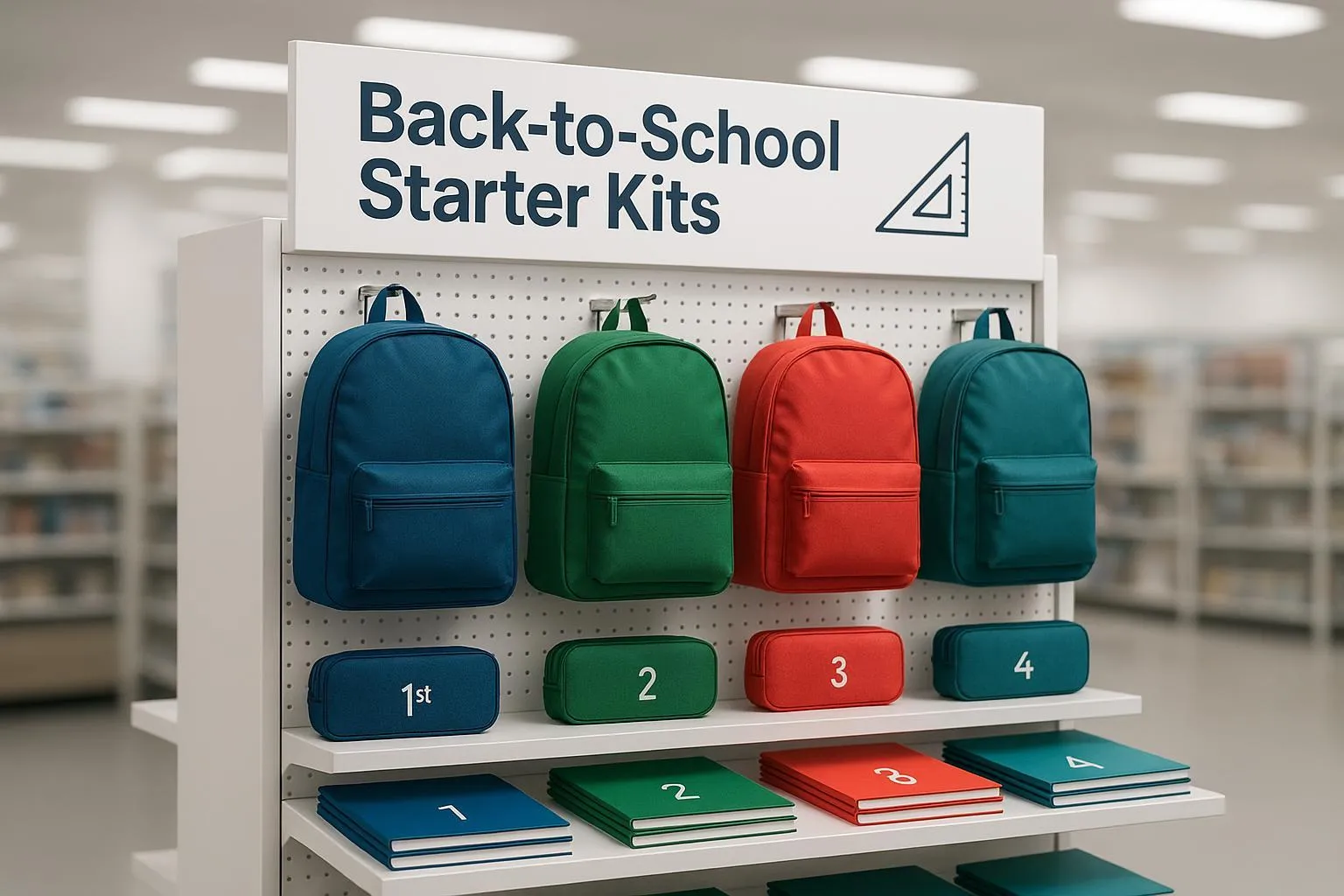
Parents shop early and fast, store teams race the clock, and your fixtures fight for attention. This guide shows how to use matched backpacks, pencil cases, and core stationery to build student starter kits that pop on shelf, speed decisions, and hold planogram discipline—all within T-90/T-60 seasonal timelines. If you’re planning back-to-school bundle merchandising across dozens or hundreds of stores, the playbooks below will keep execution tight and visibility high.
Why matched kits lift visibility and speed decisions
Matched kits reduce choice overload, surface value, and give shoppers a visual “yes.” Retailers reported earlier shopping in 2025 and sustained price sensitivity, which makes simplified, clearly priced bundles even more attractive. According to the National Retail Federation’s 2025 reporting, a majority of U.S. back-to-school shoppers begin in June–July and value clear, streamlined assortments; see the NRF’s overview on early-season behavior and timing windows in the NRF back-to-school hub. Deloitte’s 2025 K–12 survey similarly highlights restrained budgets and the influence of mid‑July promos, reinforcing the need for clear kit offers. Explorer Research recommends curated bundles to reduce decision friction in its BTS simplification guide (2025). Here’s the deal: back-to-school bundle merchandising works best when shoppers can grasp the offer in three seconds or less.
Timing guardrails you must hit: T‑90, T‑60, T‑30
Lock designs and POs before summer traffic peaks. Treat these as non‑negotiables.
T‑90 Planning Checklist (owner + due date)
| Task | Owner | Due |
|---|---|---|
| Freeze assortments by grade band and price tiers; confirm colorways | Category Manager | T‑90 |
| Lock designs/packaging; confirm unique GTIN for each pre‑packed kit; verify UPCs for components per GS1 | Merch Ops + Data | T‑90 |
| Place POs; confirm MOQ/capacity; align QC plan | Buyer + Supplier | T‑90 |
| Approve signage copy/iconography; send to print | VM + Marketing | T‑88 |
| Finalize logistics plan and buffers based on current port conditions | Supply Chain | T‑85 |
References: For barcode/GTIN rules, see GS1 2D at Retail POS Guideline (2025). For lead‑time context across production and transit, review Flexport’s Peak Season Hub (2025).
T‑60 Execution Checklist
| Task | Owner | Due |
|---|---|---|
| Production complete; initiate ocean freight; file customs docs | Supplier + Logistics | T‑60 |
| Generate and QA barcodes/labels; POS scan test (linear + 2D where supported) | Merch Ops + IT | T‑58 |
| Print signage/overlays; kit headers by grade and price band | VM + Print Vendor | T‑55 |
| Distribute planogram packs and setup recipe to stores | VM | T‑50 |
| Schedule associate training; allocate setup labor windows | Store Ops | T‑45 |
T‑30 Readiness
Use T‑30 to verify DC receipts and allocations, confirm min/max settings and replenishment windows, and photo‑audit 5–10 pilot stores. If early sell‑through or stockouts appear, tweak facings or pull forward safety stock before the national set.
Display playbooks for back-to-school bundle merchandising
Endcap kit for maximum attention
- Objective: Maximize pass‑by impressions with simplified choice. Color‑block backpacks on pegs or waterfalls; align matching cases and notebooks below; best‑sellers at eye level; bold header: grade, price band, and what’s inside. Setup time: 60–90 minutes with two associates. Agency guidance on placement and upkeep aligns with this approach; see Theory House endcap tactics.
Gondola organized by grade group
- Objective: Reduce decision friction and make restock simple. Split bay into Elementary vs. Middle/High; left‑to‑right flow from backpacks → cases → notebooks; consistent iconography and color swatches. Shelf‑talkers like “Grade 1 Essentials” help scanning. Setup: 45–75 minutes. Explorer Research’s BTS simplification guide supports curated, easy‑to‑choose sets.
POS basket that lifts attach rate
Place compact bins at checkout with pencil cases, highlighters, and erasers under a clear price threshold. Add a small “Grab & Go” sign and verify that each UPC scans cleanly at POS. You’ll create an easy add‑on path that nudges shoppers who skipped the main aisle.
Bundling mechanics that preserve clarity and margin
- SKU mix rules by grade and price band:
- Grade 1–2 value kit: 1 child‑sized backpack; 1 hard case; 2 notebooks; 1 pencil pack; 1 eraser; 1 highlighter.
- Middle school core: add binder + dividers; upgrade notebooks to wide/college‑ruled 3‑packs; include basic calculator option.
- High school/teen: capacity upgrade (laptop sleeve); planner; pen variety pack; premium case.
- Price anchoring: Lead with a good‑better‑best ladder. Keep odd‑price endings for value tiers; hold round price for premium.
- Barcode/GTIN handling: If the kit is sold as one POS item, assign a unique GTIN distinct from components and print a linear barcode (EAN/UPC). If you’re piloting 2D (GS1 Digital Link/DataMatrix), co‑locate linear + 2D during migration and validate at POS and DC. See GS1’s retail POS guideline.
- Pack‑out: Pre‑pack outer cartons sized to facings (e.g., 6–12 kits/carton) to simplify replenishment; place header cards and shelf‑talkers in the first carton.
- Promotions: Simple, benefit‑led copy such as “Backpack + Case + Essentials: ready in 1 minute.” Consider a modest %‑off duo deal (e.g., bag + case) to pull traffic into the full kit.
A fast, 45–90‑minute store setup recipe
Materials: printed planogram, header sign, side rails/overlays, peg hooks/waterfall arms, label holders, pre‑printed shelf‑talkers, zip ties, box cutter, alcohol wipes, compliance photo checklist.
Steps:
- Clear and clean the bay/endcap (5–10 min). Remove legacy labels.
- Install hardware and overlays (10–15 min). Confirm hole pattern and stability.
- Place headers and shelf‑talkers (5–10 min). Verify grade icons and price bands.
- Load backpacks by color block and size (10–15 min). Keep best‑sellers at eye level.
- Add matching cases and notebooks beneath (10–15 min). Maintain one‑to‑one visual lines from bag → case → notebook.
- Apply labels/price strips; test 1–2 POS scans (5–10 min).
- Take compliance photos; brief associates on replenishment rules (5–10 min).
Measure what matters with a simple pilot
Track visibility and conversion proxies rather than guessing. How else will you know whether your back-to-school bundle merchandising is truly working?
- Visibility: endcap traffic counts, stop rate, planogram compliance audits.
- Conversion: kit sell‑through by week, units per facing, AOV change, attach rate for case/notebook with backpack.
- Availability: OOS incidents/week, DC‑to‑store lead time, min/max adherence.
Benchmark note: Many trade sources reference uplifts for endcaps and bundles, but peer‑reviewed or publicly citable effect sizes remain scarce. Treat AOV or attach‑rate lifts as hypotheses to validate through a 4–6 week matched‑store pilot. Design a simple test (control vs. test clusters) and review weekly. For shopper timing and simplification context, the NRF back-to-school hub and Explorer Research’s guide provide useful framing.
Practical example: Grade‑1 starter kit (Knowledge Base Source)
This illustrative workflow shows how a supplier’s catalog can support a coherent, pre‑packed Grade‑1 kit. Use it as a template, not as a performance claim.
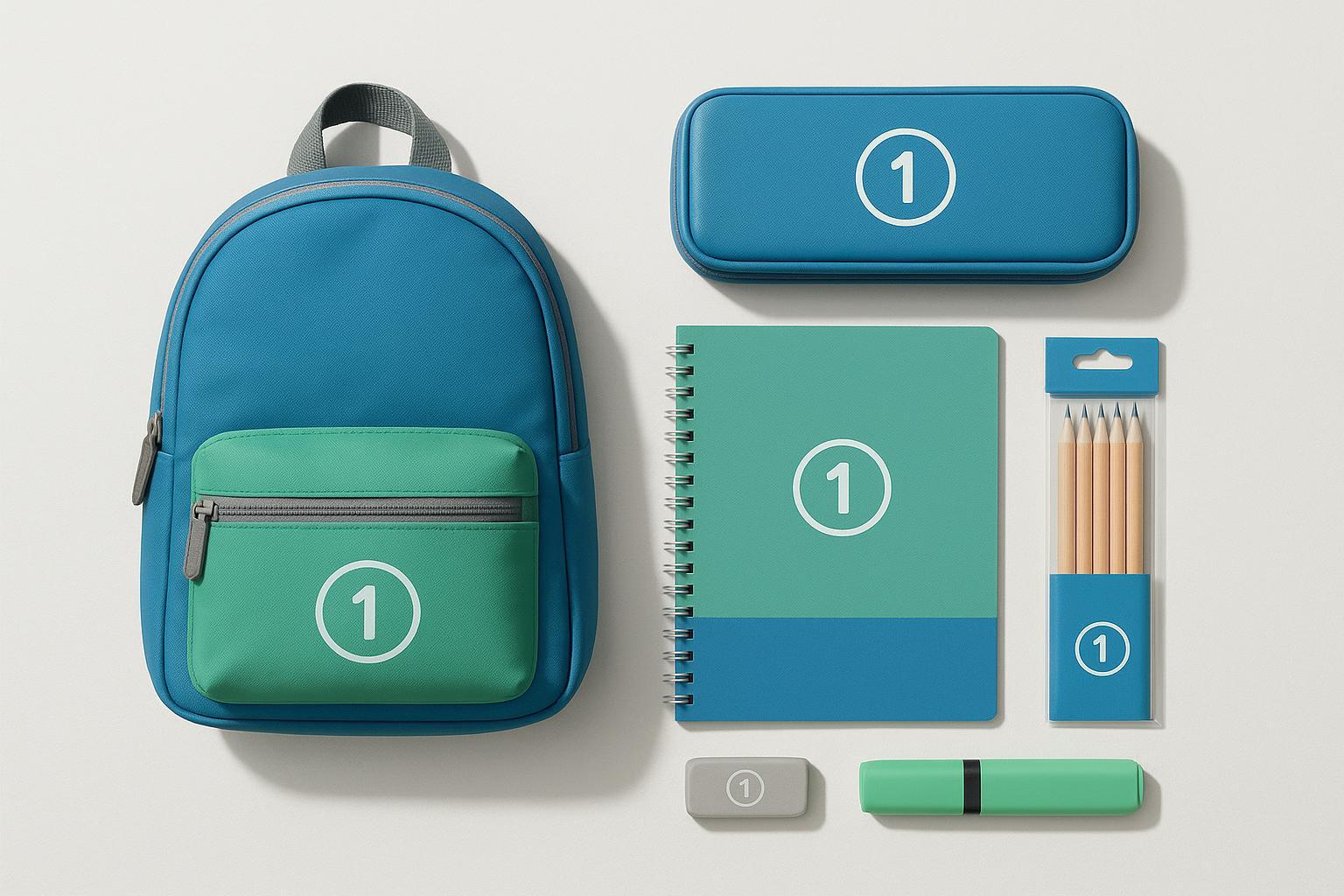
- Backpack: child‑fit, light weight (e.g., 14–16L), padded straps
- Pencil case: EVA hard shell, 20–30 pen capacity
- Notebooks: 2 spiral, wide‑ruled
- Writing: HB pencils (10‑pack), 1 highlighter, 1 eraser
Example supplier links for planning/spec review:
- Backpacks collection: Shinyyou backpacks
- Pencil cases and organizers: Shinyyou stationery cases
- Seasonal guidance: Back‑to‑school guide
Suggested compact spec table (for a value‑tier kit):
| Component | Spec | Notes |
|---|---|---|
| Backpack | 15L; padded straps; water‑resistant | Fits folders; wipe‑clean exterior |
| Pencil Case | EVA hard shell; dual zipper | Protects supplies; easy open |
| Notebooks | 2 × wide‑ruled, 70–100 pages | Color‑matched covers |
| Writing Set | 10 HB pencils; 1 highlighter; eraser | Classroom‑friendly |
Resources and next steps
- Barcode/kit integrity: review GS1 2D at Retail POS Guideline.
- Shopper timing and context: scan the NRF BTS hub (updated 2026) and Deloitte’s 2025 BTS survey.
- Display craft: browse Theory House’s endcap ideas.
Want a filled‑in starter‑kit template or sample planogram files? Download your toolkit from your internal portal, or reach out to your preferred supplier to co‑develop a grade‑banded kit set for T‑90 approvals.